
In early 1534, a 25‑year‑old tailor named Jan van Leiden (John of Leiden) walked into the German city of Münster and, with fellow Anabaptists, took it over.
He drove out or expelled most Catholics and Lutherans who wouldn’t accept the new regime. He abolished private property inside the city walls. He declared himself “King of the New Jerusalem.” Polygamy was introduced to deal with a surplus of women; Jan eventually took sixteen wives and, according to contemporary reports, personally beheaded one of them in the marketplace after she challenged his behaviour. Doors were to be left unlocked at night. Idle talk, blasphemy, and slander could all be capital offences.
He was about twenty‑five years old, and his theocracy lasted roughly sixteen months.
The Horror
Prince‑Bishop Franz von Waldeck encircled Münster with artillery and troops. By the summer of 1535, famine and disease were destroying the population inside the walls. In June the city was betrayed from within; the bishop’s forces forced the gates, stormed the streets, and slaughtered hundreds of Anabaptists.
Three leaders were reserved for something worse: Jan van Leiden, Bernhard Knipperdolling, and Bernhard Krechting.
On 22nd January 1536, they were brought to the marketplace in front of Münster’s city hall. Each man was chained upright to a post with an iron collar. For about an hour, executioners tore at their bodies with red‑hot iron tongs — chest, arms, legs — in full view of the crowd. Then their tongues were pulled out with pincers, and each was killed with a glowing dagger thrust through the heart.
Their mutilated corpses were then placed in three man‑sized iron cages and hoisted high onto the steeple of St Lambert’s Church, the main parish church on the market square. The bodies were left to rot in the air for decades; after about fifty years, the bones were removed, but the cages were left hanging.
The cages are still there.
Nearly five hundred years later, three empty iron cages still hang from the openwork spire of St Lambert’s Church in the centre of Münster. When the tower was rebuilt in the 19th century, the cages were taken down and then put back up again. Today they are lit at night. You can see them from the street.
The Modern Relic
St Lambert’s Church, on the Prinzipalmarkt in Münster, is still an active parish church. Walk into the city centre, look up at the Gothic steeple, and the three cages are right there — dark iron shapes against pale stone, hanging at almost the same height where the bodies were displayed in 1536.
Local debates have flared over the years about whether they should be removed as grisly relics or kept as history. So far, the city has kept them. The cages are empty now. They have been empty for a very long time. They are still hanging.
Nearby on the Dark Atlas
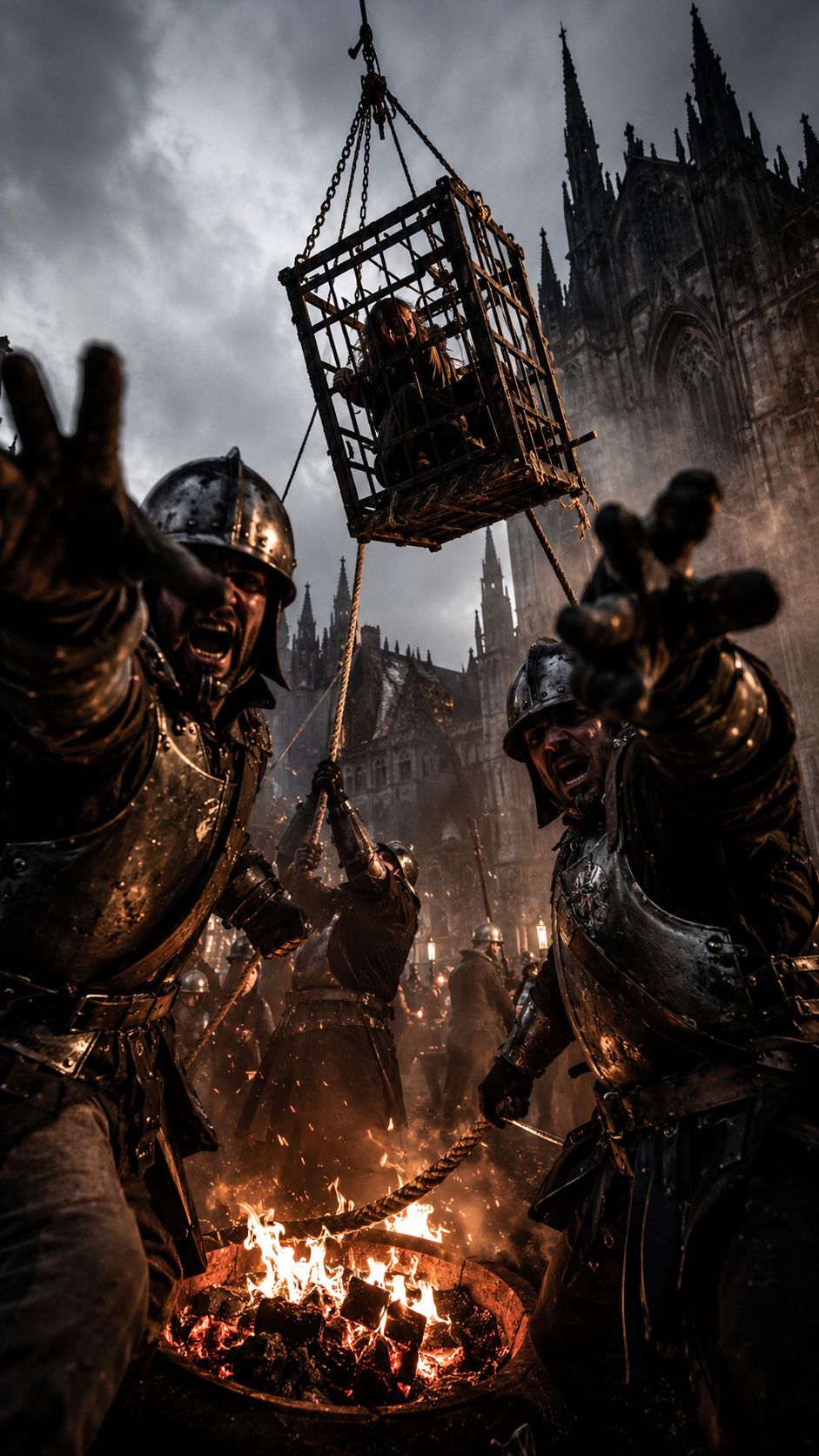 The Iron Cages Above Münster
When Münster's radical kingdom fell, its leaders' bodies were hoisted into iron cages that still hang from a church spire.
Münster, Germany · 1536 · same site
 The Betrayal That Cost Rome Three Legions
A trusted Germanic prince led three Roman legions into an ambush so total the survivors found only bleached bones years later.
Teutoburg Forest, Germany · 9 · 59 km away
- The Ballerina Who Danced for the Resistance
Before Hollywood, a starving teenage Audrey Hepburn performed secret ballets to raise money for the Dutch resistance.
Arnhem, Netherlands · 1944 · 118 km away
 The Street Where No Music Has Played For 700 Years
A real medieval town recorded that 130 of its children vanished in a single day, and no one has ever explained why.
Hamelin, Germany · 1284 · 119 km away