By the year 9 AD, Rome ruled the world. It had crushed Carthage, conquered Gaul, and turned the Mediterranean into a Roman lake. The legions were the most formidable fighting machine on Earth, and the Empire was pushing its frontier deep into Germania, the wild forested land east of the Rhine, confident it would swallow that too.
The man in charge of Germania was Publius Quinctilius Varus — an experienced administrator, former governor of Syria, son‑in‑law to one of Augustus’s greatest generals. He wasn’t a fool. But he made one fatal mistake: he trusted the wrong man.
THE HORROR — the betrayal That man was named Arminius. He was a prince of the Germanic Cherusci tribe — but he had been taken to Rome as a young hostage, raised there, given a Roman education, trained in Roman warfare, granted Roman citizenship, and made an officer of Rome’s auxiliary cavalry. He was, to all appearances, one of Rome’s own. Varus trusted him completely, kept him close as an adviser, and dined with him.
And the entire time, Arminius was planning to destroy him. He knew the Roman army from the inside — how it marched, how it fought, how it thought — and he had secretly united the fractious German tribes into a coalition for one purpose: to lure a Roman army into the deep forest and wipe it out.
In September of 9 AD, as Varus prepared to march his three legions — around twenty thousand men — back to their winter base on the Rhine, Arminius brought him a report: a distant tribe had risen in revolt. He advised Varus to take a shortcut to deal with it, off the main road, through unfamiliar wooded country. Varus, trusting his friend, agreed. Arminius then slipped away, saying he’d ride ahead to gather loyal German warriors to help.
He rode away to spring the trap. He did not come back.
THE HORROR — the slaughter The Romans marched into a nightmare of terrain. The path narrowed into a strip of land squeezed between a steep wooded hill and a vast bog, near a place we now call Kalkriese — a natural funnel, with the tribesmen waiting on the high ground behind an earthen wall they’d built in advance. The Roman column, strung out for miles and burdened with baggage, women and camp followers, could not form up.
Then the sky opened. A ferocious storm turned the ground to sludge. Roman shields, made of layered wood and leather, soaked up the rain and grew impossibly heavy. Bowstrings and the men’s footing failed. And out of the dripping trees came the javelins and spears — sudden, vicious strikes from an enemy that appeared, killed, and vanished back into the forest before the legionaries could respond.
It lasted three days.
The Romans, superb in open battle, were helpless. Their entire way of fighting depended on disciplined formations, shield walls, and clear ground — and they had none of it. They could not see their enemy. They could not deploy. Every attempt to push through was met with more ambushes from the concealing trees. They threw up a defensive camp on the first night, and again on the second, but each dawn the attacks intensified and the column bled. Discipline began to collapse. Units were cut off and overwhelmed one by one.
On the final day, in the choke point at Kalkriese, it became a massacre. The trapped, exhausted, rain‑soaked legions were surrounded and destroyed. Varus, seeing that all was lost and that capture meant torture and humiliation, drew his sword and fell on it, taking his own life. Many of his officers did the same. The rest were hunted down.
Around twenty thousand Romans died in that forest, or were dragged off to a worse fate. The Germans sacrificed captured officers to their gods on woodland altars — some burned alive in wicker cages, some with their heads cut off and nailed to the trees. Ordinary soldiers were enslaved. Almost no one escaped.
Three entire legions — the Seventeenth, the Eighteenth, and the Nineteenth — were annihilated. Wiped from existence. And the three sacred Eagles, the golden standards that were the living soul and honour of each legion, were captured and carried off into the forest as trophies. To lose an Eagle was the deepest shame a legion could suffer. Rome lost three in an afternoon.
THE HORROR — the Emperor When the news reached Rome, it broke the most powerful man in the world.
The Emperor Augustus — who had ruled Rome for forty years, who had turned a republic into an empire, who was worshipped as very nearly a god — came apart. The historian Suetonius records that Augustus was so shattered that for months he let his hair and beard grow untrimmed in mourning. And that he would, again and again, beat his own head against the doors of the palace, crying out a single anguished sentence:
“Quinctilius Varus, give me back my legions!”
He kept the anniversary of the disaster as a day of mourning for the rest of his life. The old man never got over it.
THE MODERN RELIC Six years later, in 15 AD, the Roman general Germanicus led an army back into that forest, to the site of the disaster, to bury the dead at last. The historian Tacitus describes what they found — and it is one of the most haunting passages in all of ancient literature.
They came into the clearing and found it as the Germans had left it. Bleached white bones scattered across the open ground where men had fled and fallen. Heaps of them where the legions had made their last stands. Broken spears and the limbs of horses half‑buried in the earth. The remains of the crude ramparts thrown up on those desperate nights. And, nailed to the trunks of the surrounding trees, the skulls of the Roman dead — and the altars where the captured centurions had been sacrificed. Old soldiers wept as they gathered the bones of comrades and strangers alike and heaped them into a burial mound, no man able to tell whether the bones he lifted belonged to a friend or an enemy.
Rome never conquered Germania. The Rhine became the permanent frontier of the Empire, and stayed that way for four hundred years. The forest had stopped the greatest war machine in the world dead, and the direction of European history bent around that single defeat: the Germanic peoples remained free and un‑Romanised, which is a large part of why the map of Europe, its languages and its nations, looks the way it does today.
And the relic came out of the ground in our own lifetime. For centuries no one even knew for certain where the battle had happened. Then, in 1987, a British amateur archaeologist named Tony Clunn, hunting with a metal detector near Kalkriese in Germany, began pulling Roman coins and lead sling‑shot out of the earth — and uncovered the battlefield itself. Archaeologists have since excavated it, and found the bones, the German earthwork wall, and the debris of the slaughter still in the mud.
The most haunting object they raised is on display at the Kalkriese Museum today: an iron Roman cavalry face mask, once silvered, that a Roman horseman wore into that forest — a blank, staring human face, pulled from the German soil two thousand years after the man behind it was cut down. You can stand in front of it now, and look into the empty eyes of one of Varus’s lost legions.
Three legions marched into the trees. An emperor beat his head against a door. And a silver face still stares up out of the mud where they died.
Nearby on the Dark Atlas
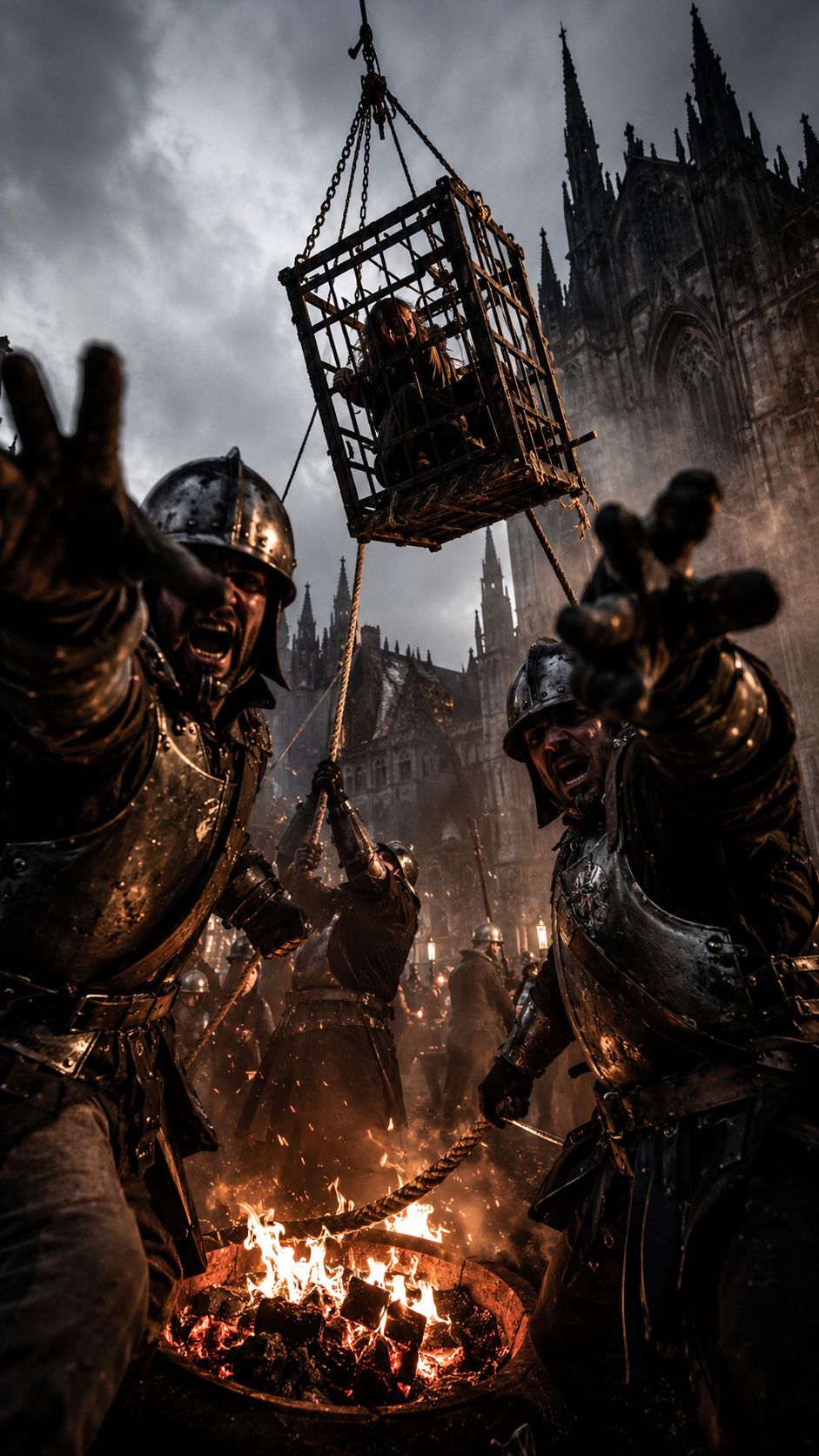 The Iron Cages Above Münster
When Münster's radical kingdom fell, its leaders' bodies were hoisted into iron cages that still hang from a church spire.
Münster, Germany · 1536 · 59 km away
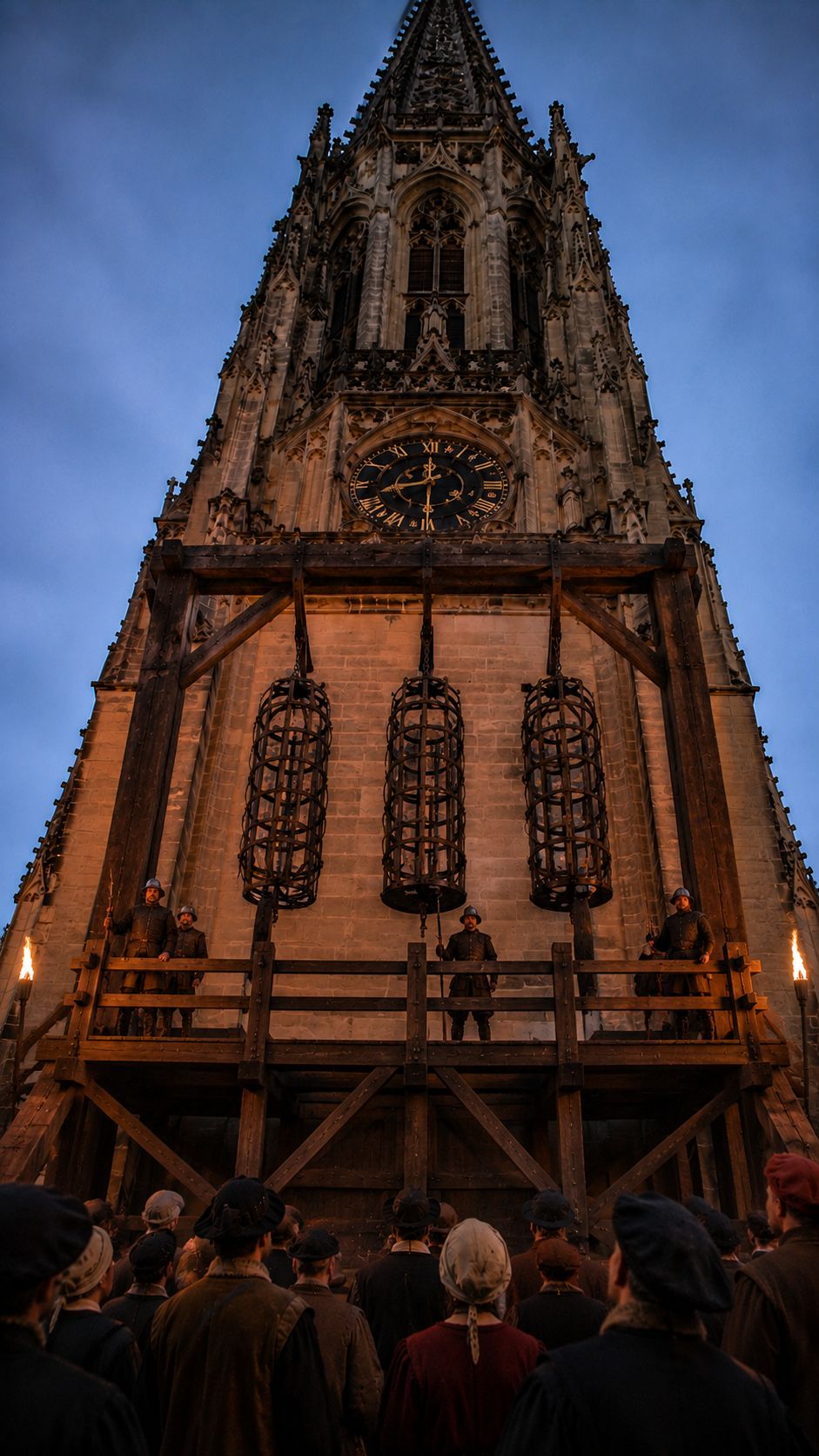 The Tailor Who Crowned Himself King
A 25-year-old tailor seized a German city, took sixteen wives, and declared himself king of a new Jerusalem.
Münster, Germany · 1534 · 59 km away
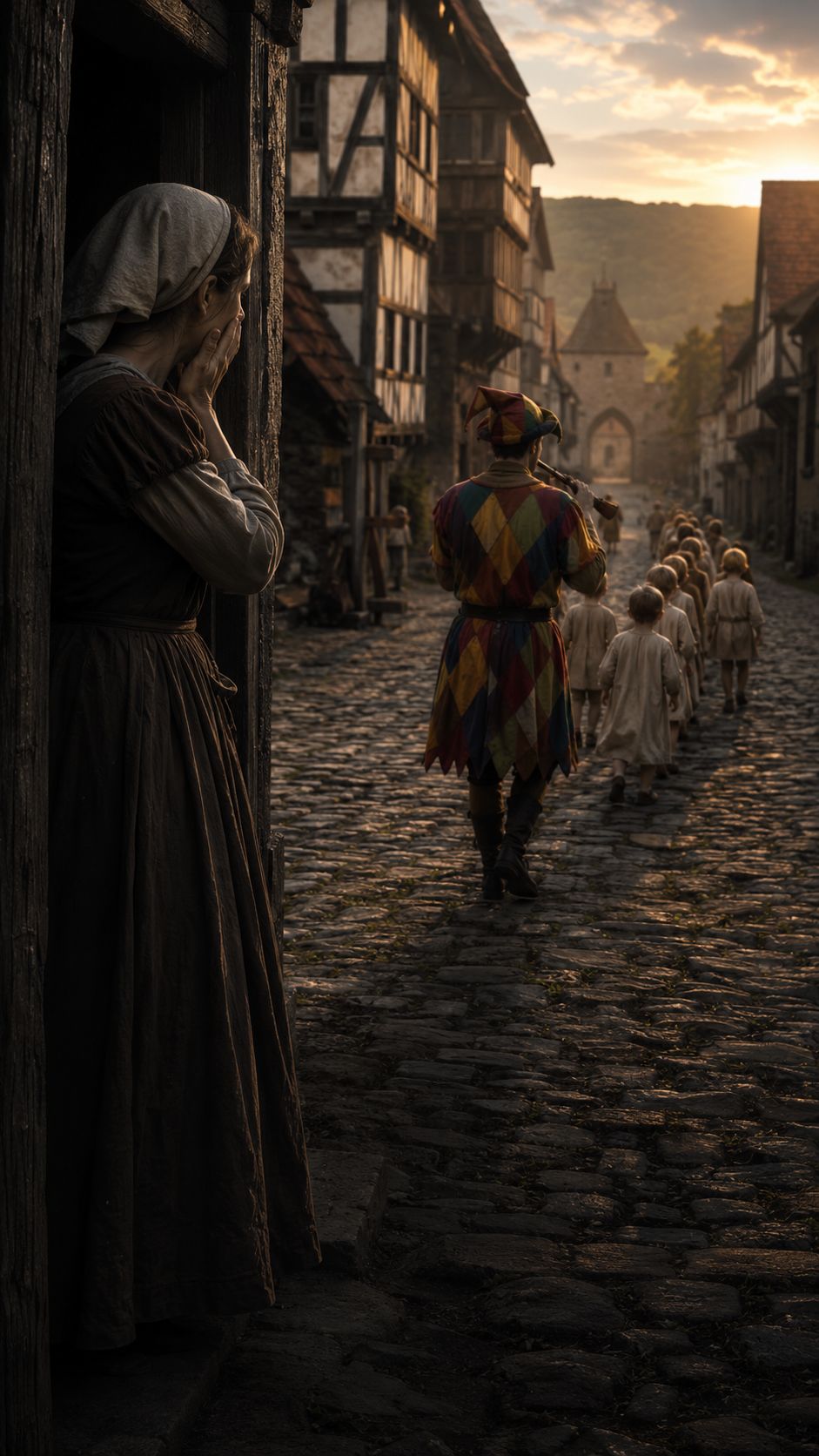 The Street Where No Music Has Played For 700 Years
A real medieval town recorded that 130 of its children vanished in a single day, and no one has ever explained why.
Hamelin, Germany · 1284 · 60 km away
- The Blood And Blindness In The Original Cinderella
There is no fairy godmother in the Grimms' first Cinderella, only a grave, mutilation, and eyes pecked out by birds.
Kassel, Germany · 1812 · 104 km away