The Horror
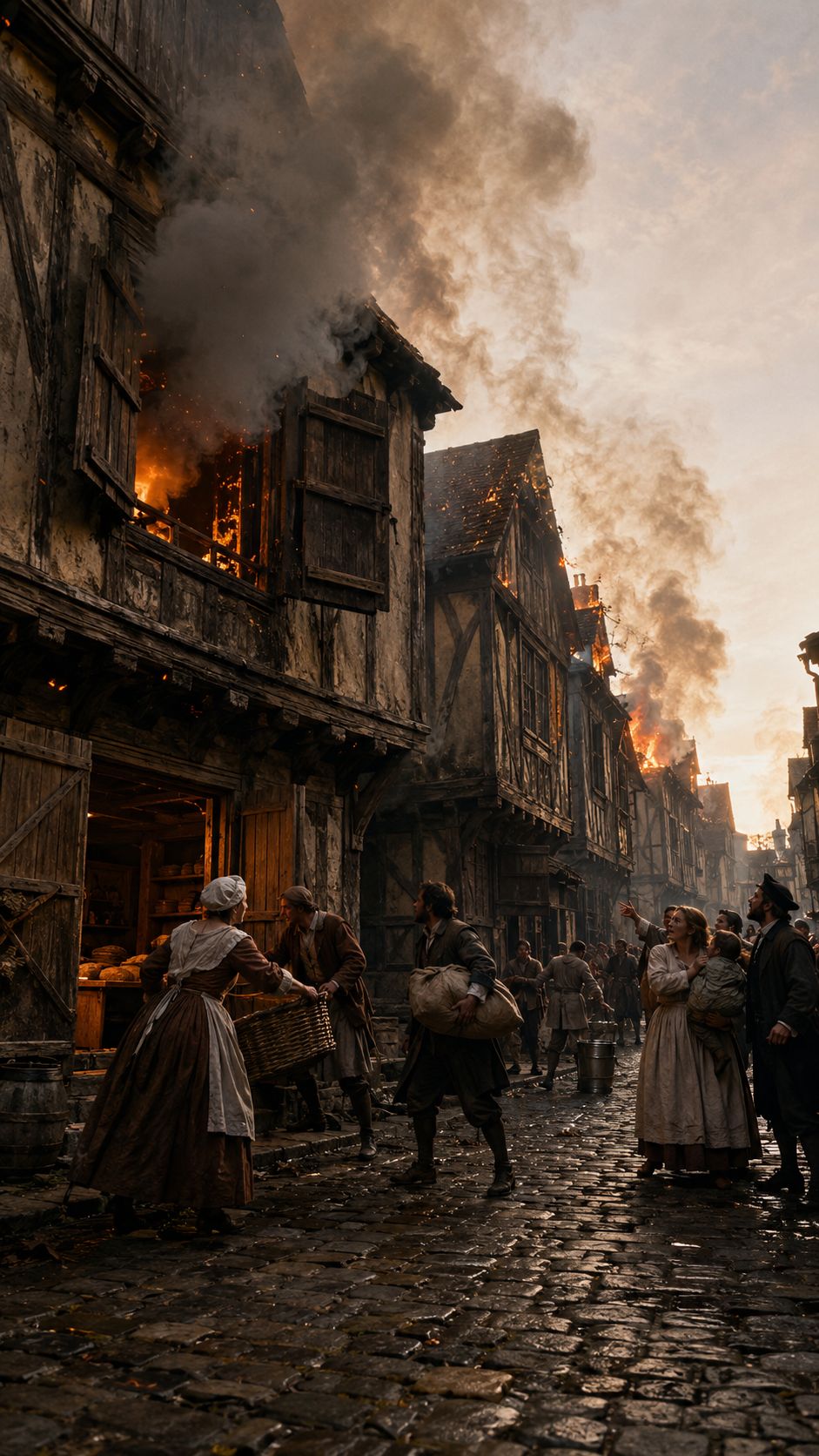
The Great Fire of London burned on the north bank in 1666 and spared the Borough entirely. Southwark’s turn came ten years later. On 26 May 1676 fire broke out on Borough High Street and worked along the frontage, and what it consumed was not a district of houses but a district of inns.
Borough High Street was the mouth of London. Every traveller coming up from Kent and the Channel ports followed the old Roman road through Southwark to reach London Bridge, and the street had been lined for centuries with galleried courtyard inns built to take them in: the White Hart, the Queen’s Head, the Tabard, the George. The fire destroyed the George completely.
What stands at 77 Borough High Street today is the rebuilding of 1677, put up in timber frame and brick on the old plan — a date recorded both in the Grade I listing and in the National Trust’s own heritage file. An inn of the same name had stood here since at least the sixteenth century, and the cellar still holds reused beams and squared stonework the listing describes as of possible medieval origin.
The horror of the George is not a single death. It is a slow dismemberment, and it was done for money.
The rebuilt inn was a quadrangle: ranges on three sides of a cobbled yard, with open galleries running the full length of each so that passengers could reach their rooms without entering the building. One surviving room was the waiting room and is still called the Parliament Bar; another was the coffee room and is now the Middle Bar. The complex reached well back from the street, past ranks of stabling, towards Guy’s Hospital, which held the freehold.
Then the railways came, and the coaching trade they ended was the only trade the George had. Guy’s sold the site to the Great Eastern Railway, which used part of the inn as offices and then began demolishing it for goods warehousing. The listing records the north range coming down in 1874; the National Trust’s own file gives 1889 for the same demolition, so the year is not settled. The outcome is not in question. Two of the three ranges were pulled down for railway sheds, and what was left was a single south range looking out across a yard with nothing on the other side of it.
The last act was nearly the end. By the 1930s the site belonged to the London and North Eastern Railway, the Great Eastern’s successor, which argued the remaining building was so dangerous that repair would cost too much and demolition was the sensible course. The Society for the Protection of Ancient Buildings surveyed it and flatly contradicted the railway: the structure was sound and could be repaired affordably. Its report, still in the SPAB archive, added a line that has aged well — “although there is much that can be done, there is even more that would be better left undone to preserve the individual quality of this building.” In 1937 the LNER handed the George to the National Trust rather than pay for it, and the eastern section was rebuilt the same year.
The Shakespeare Problem
Two literary claims attach themselves to the George, and one of them is simply a mistake.
The Tabard Inn, where the pilgrims of Chaucer’s Canterbury Tales meet before setting out under a host named Harry Bailly, stood next door. It was not the George. Founded around 1307 by the Abbot of Hyde, the Tabard was rebuilt after fire and reopened under the altered name of the Talbot, and was demolished in 1873. The yard alongside the George still carries the name Talbot Yard. The two inns shared a frontage, and when one survived it inherited the other’s fame, which is why guidebooks, plaques and articles routinely describe the George as Chaucer’s inn. It has no connection to The Canterbury Tales whatsoever.
The Shakespeare claim is thinner than its popularity suggests. The best-known book about the pub is Pete Brown’s Shakespeare’s Local, and Brown has written publicly that he “failed to prove the contention in the title of the book,” observing that when he wrote it “there was not one single mention of Shakespeare ever having been recorded as being in any pub, ever.” He has since argued that the only documentary hint pointing to that stretch of Borough High Street points at the Tabard instead. The George stands a few minutes from where the Globe and the Rose stood, and inn yards of this shape were genuinely used for playing. That is the whole of it. No record places Shakespeare at the George.
Dickens is the connection that survives scrutiny, and it is a modest one. The George is named in Little Dorrit, chapter 22, where a character goes “into the George and writes a letter” — the coffee room doing the work it did in life. Dickens knew the Borough as well as anywhere, having lived in Lant Street while his father was in the Marshalsea. That he drank at the George is repeated everywhere and is plausible, but no first-hand record of it surfaced in the sources consulted here, and it is better read as tradition than documentation.
The Ghosts
The ghost claims at the George need sorting by how much weight each will bear.
The most cautious version is in the Paranormal Database, which records the “nondescript shape of a female figure” seen drifting in the bedrooms of the old coach house. It gives no date, no witness, and cites only published media.
The popular version names her. In ghost writing she is Miss Murray, a former landlady, held responsible for a pointedly modern set of grievances: tills opening by themselves, electronic systems crashing without cause, unexplained shapes on the security cameras. The story goes that she objects to the technology. The forename Amelia is attached to her in retellings, and it is worth saying plainly that no source found here supports it, and that no documentary record of a landlady named Murray at the George turned up at all. What exists is a surname carried in ghost literature, a forename that appears to have accreted later, and a set of faults common to any old building full of wiring.
The third claim is a cellar apparition described as a laughing cavalier: a moustachioed figure in Civil War dress who forms out of a shimmering light, stares, laughs and vanishes. The earliest account attached to it is a foreman’s, during building work in the 1970s. He is not named. Neither is anyone else.
The Modern Relic
The George is open, and the relic is the whole point of the visit. Walk into the yard off Borough High Street and the surviving south range is in front of you: three storeys with dormers above, and two tiers of galleries, the lower carried on cantilevered beams and the upper on wooden Doric columns. The windows are a jumble of seventeenth, eighteenth and nineteenth-century work, which is what an honestly repaired building looks like.
Inside, find the early eighteenth-century dogleg staircase with barleytwist balusters, and the fielded panelling and bolection-moulded overmantels in the ground-floor rooms. The Parliament Bar and Middle Bar keep their coaching-era names, and the interior is on CAMRA’s National Inventory of Historic Pub Interiors. The building has been Grade I listed since March 1950.
It stands at 77 Borough High Street, SE1 1NH, two minutes from London Bridge station, owned by the National Trust since 1937 and leased to Greene King — a working pub rather than a museum, and the last galleried inn left in London. Stand in the yard and the absence is the exhibit: the open side is where the other two ranges stood until the railway took them.