
Captain William Kidd was not sent out as a pirate. He was a privateer — commissioned by the English Crown, backed by some of the most powerful lords in Parliament, and ordered to hunt pirates and enemy shipping in the Indian Ocean on their behalf. When the politics shifted, the men who had signed his commission let him take the blame.
He was tried at the Old Bailey in May 1701 on charges of piracy and murder. Kidd insisted that he had attacked only legitimate prizes. The key evidence he pinned his hopes on were French passes — documents showing that some of the ships he had taken were sailing under French protection, making them lawful targets in wartime. Those passes were in the hands of the authorities. They were never shown to the jury. The papers were filed away in government collections and forgotten. Modern researchers only rediscovered them centuries later in volumes at the Public Record Office (now The National Archives), exactly where they had been tucked among other Colonial Office documents.
He was convicted on all counts. He was about fifty‑six years old.
The Horror
On the afternoon of 23 May 1701, Kidd was taken from Newgate Prison in a horse‑drawn cart, escorted by officials of the Admiralty. The procession was led by the Admiralty Marshal carrying a silver oar — the symbol of the Admiralty’s authority over crimes at sea. Contemporary accounts note, with disapproval, that Kidd had fortified himself with drink.
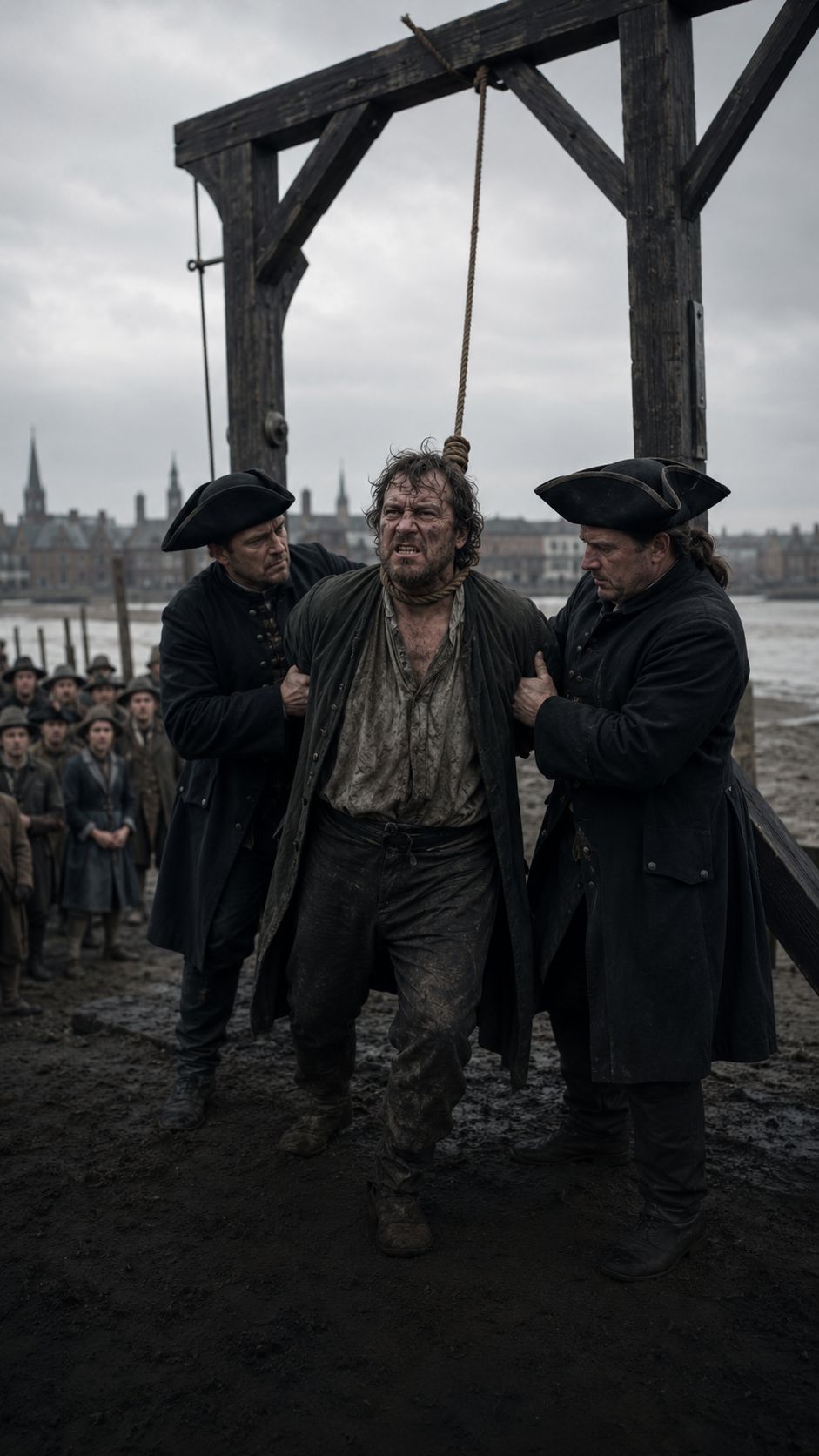
The execution took place at Execution Dock in Wapping, where a gallows stood down on the foreshore at the low‑tide mark to show that the sentence fell under maritime law. The drop at Execution Dock was traditionally short; it did not snap the neck, but slowly strangled the condemned, whose jerking movements led spectators to say that men “danced the Tyburn jig” or “danced” as they died.
Kidd addressed the crowd, warning shipmasters to take care how they trusted great men and commissions. Then he and several other condemned men were “turned off” the ladder. As he dropped, Kidd’s rope snapped. He fell into the thick Thames mud, alive, dazed, the noose still around his neck.
Execution was not over. By law and custom, the sentence had to be carried out. The officers and chaplain moved quickly. After prayers were said over him again, Kidd was hoisted up and hanged a second time. This time the rope held.
For pirates and other maritime criminals, death on the gallows was not the end. By Admiralty custom, the body was left hanging at Execution Dock until three tides had washed over it. After that, the corpses of notorious offenders were sometimes taken down, coated in tar to slow decay, locked into man‑shaped iron cages, and hung from gibbets at prominent points along the river such as Tilbury, where every ship entering or leaving London would pass.
Kidd’s body was gibbeted in this way as a warning. It hung for years above the Thames, exposed to sun, wind, and birds. Rot and scavengers did their work. Bones fell. Pieces of the cage corroded. Visitors and sailors were said to take fragments as grim souvenirs. Every merchant captain, every sailor, every passenger bound for the largest port in the world would sail past the tarred outline of a man in iron, swinging over the water. That was the point.
The Modern Relic
The gallows and gibbets are gone. Today, three riverside pubs in Wapping claim some connection to Execution Dock: the Prospect of Whitby, the Captain Kidd, and the Town of Ramsgate. The most likely spot is beside the Town of Ramsgate. Slip down the narrow alley on its western side and you will find Wapping Old Stairs — a steep flight of stone steps leading down to the exposed Thames foreshore at low tide.
At low tide, you can stand on the mud and shingle where pirates, smugglers, and mutineers were once hanged as the river rose around them — somewhere very close to where Kidd fell when the rope broke and lay stunned with the noose still around his neck. The tides still come in. The silver oar is preserved in the Admiralty courts. The French passes that might have changed his trial sit in climate‑controlled archive boxes. The warning he became is now a riverside view.
Nearby on the Dark Atlas
 The Pirate Hanged Twice In One Morning
A respected captain became a public scapegoat for piracy, and even his execution refused to go as planned.
London, United Kingdom · 1701 · same site
- The Body Left to Rot in the Tides
A tarred corpse was caged in iron and hung above the river, left for the rising tides to slowly consume.
Execution Dock, London, United Kingdom · 1700 · same site
- The Truth Behind The Elephant Man
The real man behind the famous film was quieter, stranger and far more heartbreaking than any screenplay.
Whitechapel, London, United Kingdom · 1890 · 1.4 km away
 Fourteen Years in the Tower for His Bloodline
Locked away as a boy for the crime of his birth, he emerged so isolated he could no longer recognize an animal.
Tower of London, London, United Kingdom · 1499 · 1.5 km away