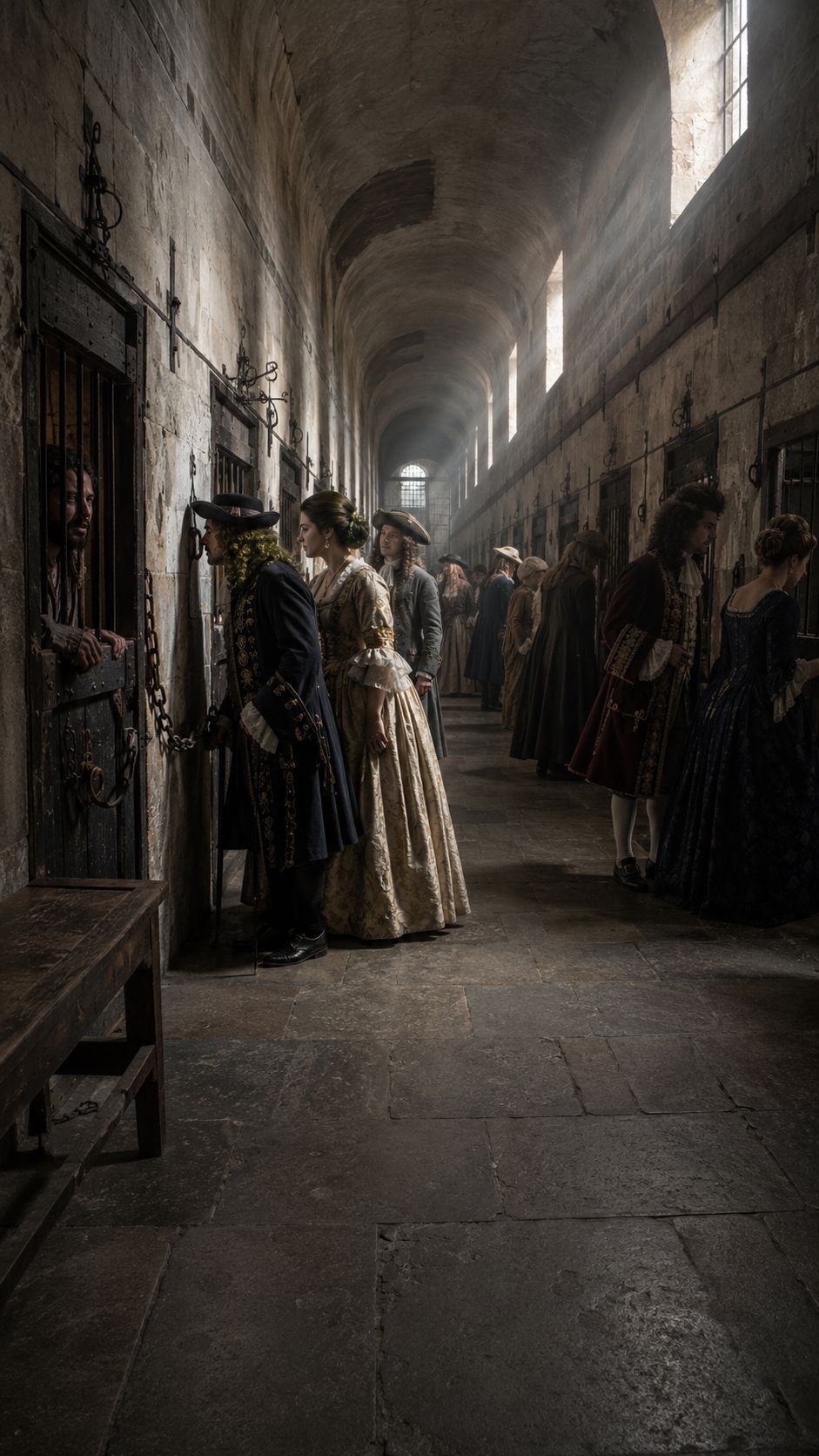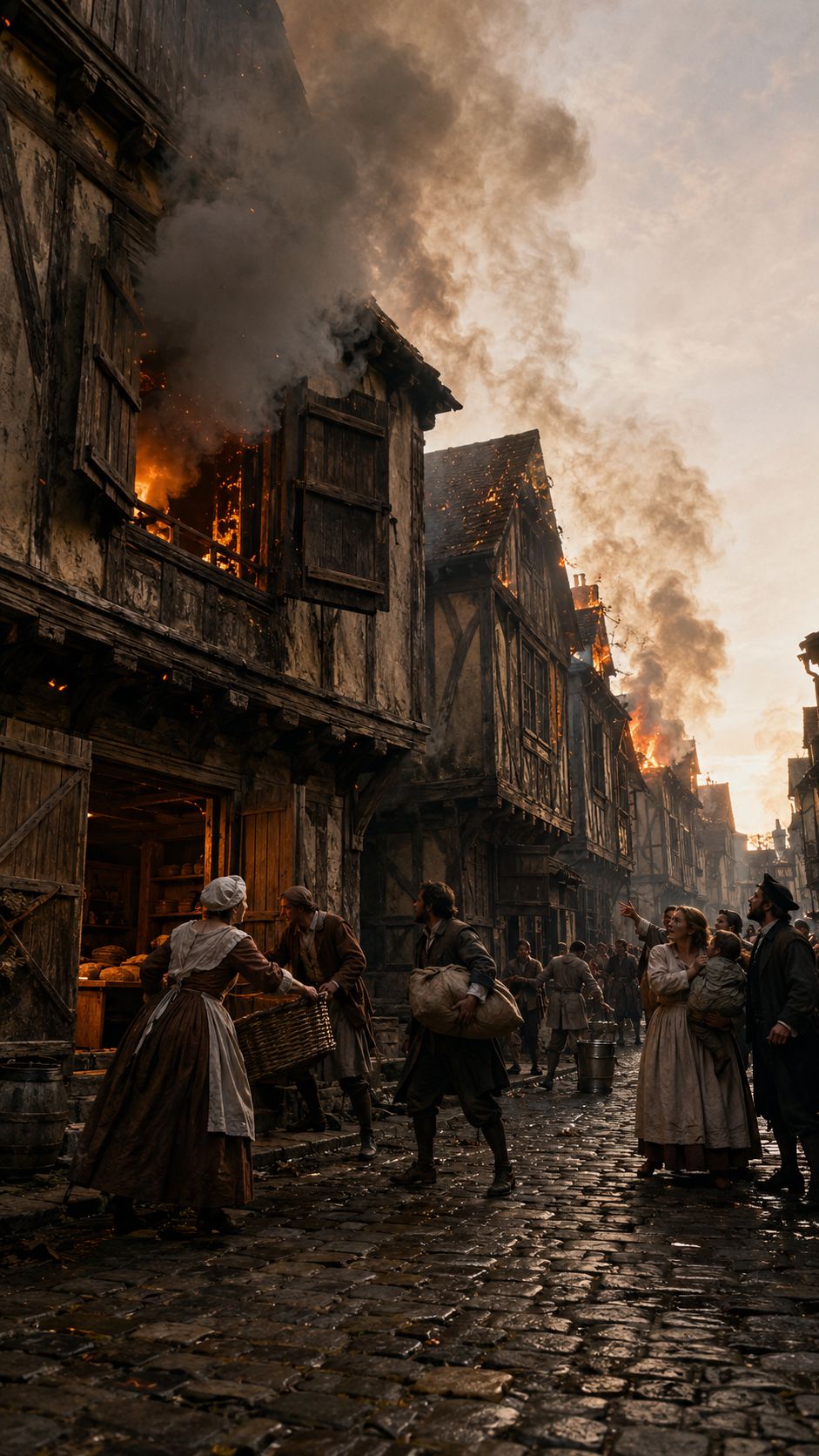
London’s bills of mortality recorded 68,596 plague deaths in the city in 1665. Contemporary counting was poor, dissenters and the very poor often went unrecorded, and the true figure is usually put nearer 100,000. The dying was not spread evenly across a year and a half; it gathered through the summer, peaked in September, thinned over the winter, and had eased enough by February 1666 for Charles II to come back to town.
The burial system buckled under that. Churchyards that took a few dozen bodies a year were handed several hundred a month, and some parishes responded by digging pits.
What the record does not support is the familiar image of a city that buried everybody that way. Vanessa Harding’s study of the parish evidence concludes that most and perhaps all of the larger suburban parishes ended by burying their plague dead in mass graves, while the smaller parishes in the centre of the city never needed to. The quicklime of popular retelling belongs to the wrong year altogether: it was prescribed in Privy Council orders issued in May 1666, after the epidemic had burned out. Most of the 1665 dead were buried as Londoners were normally buried, in parish ground, in coffins or shrouds, a few feet down.
They are still there. That part is true, and it is the least sensational part of the story.
The Horror
Nearly every vivid detail that circulates about the plague pits traces back to one book. Daniel Defoe’s A Journal of the Plague Year was published in March 1722, fifty-seven years after the event, by a man who had been five years old in 1665. It is narrated by a fictional H. F., probably modelled on Defoe’s uncle Henry Foe, and it was read as reportage for decades before being accepted as fiction from the 1780s onward. Defoe worked from real bills of mortality and real street names, which is precisely why the invention is so hard to separate out.
The Aldgate pit is the clearest case. The story that it received its first corpse on 6 September and held 1,114 bodies within a fortnight is not drawn from a parish register or an excavation report; Harding, quoting the figure, attributes it to pages 77 and 78 of Defoe’s novel. Pits were dug at St Botolph Aldgate in August 1665, and the churchyard there was under real pressure. The arithmetic everyone repeats is a novelist’s.
Aldgate station opened on 18 November 1876, built by the Metropolitan Railway as a shallow cut-and-cover line beside that churchyard, and it is often said that construction was held up by a pit of about a thousand bodies behind St Botolph’s. The figure is Defoe’s, restated as engineering history.
Then there is the claim that has been repeated so often it has been printed as a tube fact: that the line between Knightsbridge and South Kensington was built on a curve to avoid a plague pit. No engineering record supports it, and two things argue against it. The first is depth. That stretch is deep-level bored tube, opened in December 1906, running far below the ground that holds early modern burials; where Crossrail’s archaeologists worked at Liverpool Street, the burial deposit reached only about three metres down from the surface of the street, while deep tube tunnels sit well beneath that, and the platforms at Hampstead are 58.5 metres below the surface. The second is that railways did not avoid burial grounds when the route wanted to go through one. They dug, and dealt with what came up.
The explanations offered for the curve by railway enthusiasts and historians, which are reasoning rather than documented proof, all sit above ground rather than below it: the alignment of the roads overhead, the wish to avoid disturbing surface buildings and inviting compensation claims, the need to keep clear of the rival Metropolitan Railway’s own sub-surface tracks, and geometry inherited from the District Railway’s deep-level express scheme between South Kensington and Earl’s Court, which was authorised and then abandoned once electrification in 1905 made it unnecessary.
The genuinely documented case is Liverpool Street, and it is better than the myth. The New Churchyard was opened in 1569, London’s first burial ground unattached to any parish, created after the epidemic of 1563 overwhelmed the local churchyards. It lay next to Bethlem Hospital, which is where the name Bedlam attached to it; the name is geography, not a hospital cemetery. Those buried there included servants, strangers, suicides, religious non-conformists, the unclaimed bodies of former prisoners and plague victims, alongside a number of better-off families. It closed in 1739, with an estimated twenty to twenty-five thousand interments in roughly an acre of ground.
Between 2011 and 2016, Crossrail’s excavations for the Liverpool Street station took out around three and a half thousand graves, with 3,354 burials recorded. In 2015 the archaeologists reached something different from the rest: a grave holding several dozen individuals laid down at the same time, with a headstone nearby cut with the date 1665. Jay Carver, Crossrail’s lead archaeologist, was careful at the time, calling it very likely a reaction to a catastrophic event and the best candidate for a plague pit while the dating was still unknown. In 2016 teeth from twenty of those skeletons were tested at the Max Planck Institute and showed Yersinia pestis, the first genomic confirmation that Great Plague victims in London died of the plague bacterium rather than something else.
Charterhouse Square gave the other half of the picture. Twenty-five skeletons were uncovered there in March 2013, thought from documents and pottery to be emergency burials from the arrival of the Black Death in the winter of 1348, and the same bacterium was identified in their teeth. Radiocarbon dating then complicated the neat story: some of those buried had been interred as late as the fifteenth century, which means the ground was used across generations of outbreaks rather than filled in one catastrophic season.
The Modern Relic
None of this is preserved as heritage. London’s early modern burial grounds are treated as subsoil in a working city, and the law sets out what happens when a scheme reaches them: an exhumation licence, archaeologists on site, recording, analysis, and reburial in an appropriate burial ground. At Liverpool Street around six hundred skeletons were retained for scientific study before reburial, with the intention of bringing the remains from the different phases of work together in a single plot. Where construction does not go deep enough to reach burials, nothing is done, because nothing needs to be.
How many such sites lie under the modern city is a question worth resisting. There is no authoritative tally, and the confident figures that circulate are mostly repetition. Harding notes that W. G. Bell, whose popular history shaped a great deal of later writing, was in general a rather uncritical reporter of plague pits, and much of what is now presented as a map of London’s mass graves descends from exactly that kind of reporting. The record supports a scatter of documented burial grounds and some documented pits. It does not support a subterranean city of them.
So the everyday truth is quieter than the legend and harder to dislodge. Several million journeys a day pass over ground that has taken the dead of more than one epidemic, in places only a few metres above them, with no plaque and no announcement. The trains do not swerve. They were never asked to.