
Giles Corey is one of the most extraordinary figures in the history of American colonial justice — an elderly farmer who turned his own execution into an act of defiance so absolute that it has echoed through legal history for more than three centuries. He did not save himself. He saved his land. And he did it by refusing, over two days of agony, to give his tormentors the one thing they needed: a plea. Corey was born in England around 1611 and emigrated to Massachusetts Bay Colony, where he became a prosperous farmer in Salem Village. He was known as a stubborn, litigious man — he had been fined and whipped for theft in his youth, and in his sixties he had beaten one of his own farmhands so severely that the man died months later. Corey paid a fine and walked free. By 1692, he was 81 years old, a property owner with adult children, living with his third wife, Martha. And then the witchcraft panic came for them.
The Horror
In March 1692, Corey’s own farmhands — including a man he had recently fired — accused him of witchcraft. They claimed they had seen his spectre tormenting the afflicted girls. His wife Martha was also accused, and would hang three days after his death. Corey was arrested and brought before the court. Under English law, a defendant had to enter a plea — guilty or not guilty — before a trial could proceed. If he pled guilty, his property was forfeited to the Crown. If he pled not guilty and was convicted, the same. But if he refused to plead at all — if he stood mute — the court could not lawfully seize his estate. His sons would inherit. The penalty for standing mute was peine forte et dure — strong and hard punishment. On 17 September 1692, Corey was taken to an open field near Salem, stripped naked, and laid on the ground. A board was placed over his chest. Heavy stones were piled on top. The goal was to crush him until he entered a plea, or died. For two days, the stones grew heavier. On the first day, he was asked to plead. He said only: “More weight.” On the second day, as his body was slowly compressed, his tongue bulged from his mouth from the pressure. The sheriff is said to have pushed it back in with his cane. Local legend holds that Corey’s tongue rolled out again after his death, and that the sheriff who had pressed it back died of a hemorrhage shortly afterward — a superstitious footnote to a real horror. Through it all, Corey gave them nothing. No plea. No confession. No admission of guilt. Only those two words. He died around noon on 19 September 1692. Because he had never pled, his property could not be seized. His sons inherited his farm. His wife Martha was hanged on 22 September, one of nineteen people executed in the Salem witch trials. Giles Corey was the only person in American history to be pressed to death by a court of law.
The Modern Relic
The relic is the field. The site of Corey’s pressing is believed to be near the old Salem jail, in what is now Danvers, Massachusetts — a quiet suburban area where houses and streets have paved over the farmland of 1692. There is no monument at the exact spot where the stones were piled. But Corey and his wife are remembered in Salem’s witch trial memorial, where their names are carved in granite alongside the others. And the legal principle he died for — that a man cannot be forced to incriminate himself — would eventually find its way into the Fifth Amendment of the United States Constitution, written nearly a century later. An 81-year-old farmer, crushed to death in a Massachusetts field, whispering “more weight” while the Crown tried to steal his land, helped build the right to remain silent.
Nearby on the Dark Atlas
- The Enslaved Woman Who Started the Salem Witch Trials
Her confession to save herself named two other women as witches, setting off accusations that would kill twenty people.
Salem, United States · 1692 · same site
 The First to Hang at Salem
Convicted on nothing but a dream of her spectre, she was the first person executed in the Salem witch trials.
Salem, Massachusetts, United States · 1692 · same site
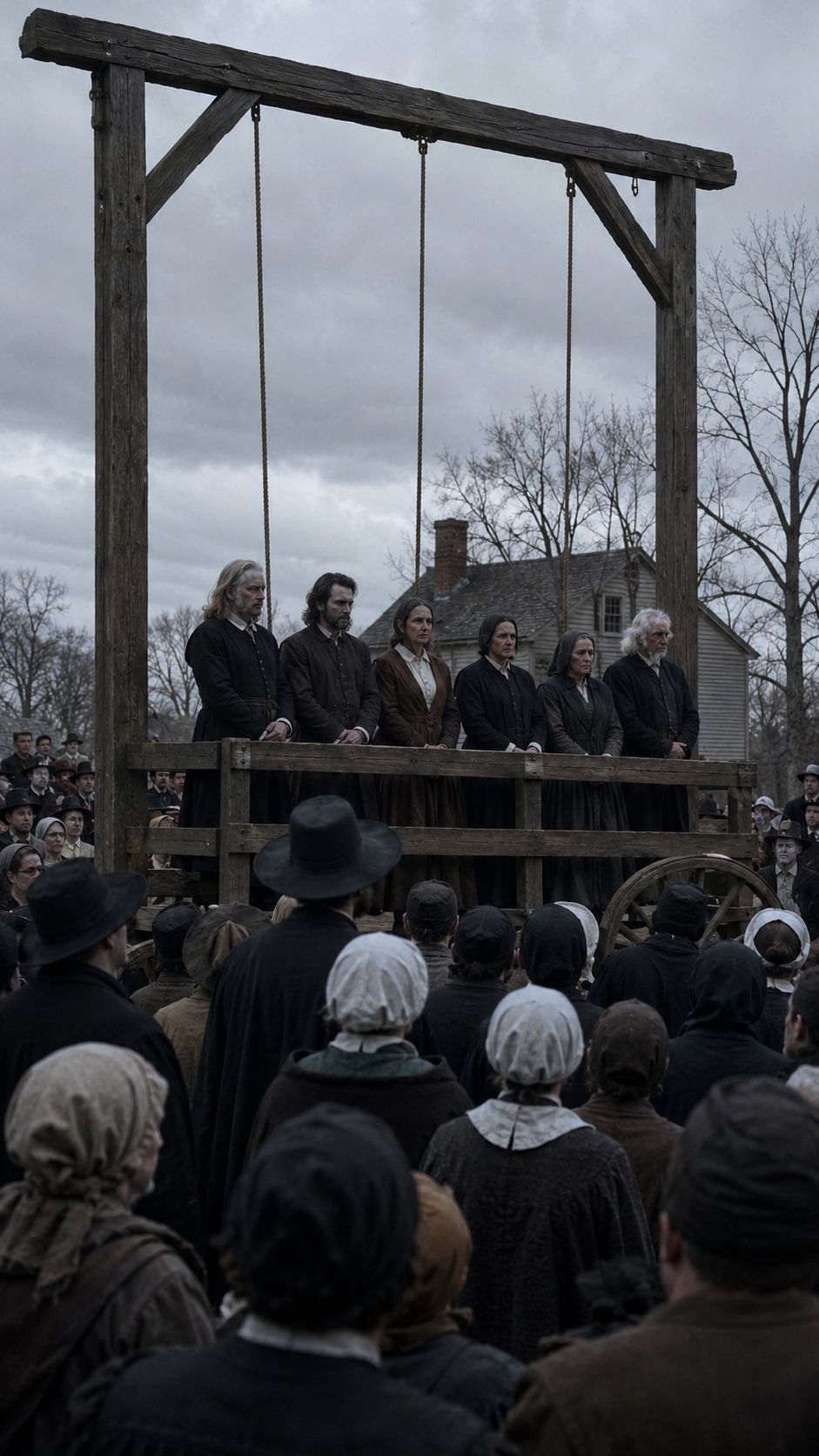 The Killing Ground of Salem
A colonial village turned mass hysteria into mass execution, hanging dozens on a single barren ridge.
Salem, Massachusetts, United States · 1692 · same site
 America's First Woman Hanged For Piracy
A farm girl drawn to the docks confessed to almost every crime imaginable the day before she was hanged in Boston.
Boston, Massachusetts, United States · 1789 · 22 km away