
Rachel Schmidt was born around 1760 on a farm outside Carlisle, Pennsylvania, to strict, devout Presbyterian parents. She hated it. She was drawn to the water — to the docks, the boats, the noise and the sense of freedom along the waterfront — and at sixteen she left home and never went back. On the docks she met a fisherman named George Wall, a veteran of the Revolutionary War, and married him. It was the decision that ruined her, and she knew it. In her own words, written down the day before she died, he was the man who enticed her to leave her honest service and fall in with bad company — and, she said, from that she could date her downfall.
THE HORROR The Walls drifted to Boston. George came and went. Rachel took work as a domestic servant in the wealthy houses of Beacon Hill, where — in her own account — she lived very contentedly. But George always came back, and he always pulled her back down. By her own confession, she slipped into a life of small thefts: gold from a sleeping captain’s cabin in 1787, a silver watch from a sloop in 1788, robbing people in the streets. Petty crime, committed by an uneducated woman in a hard post‑war city where the only “respectable” work open to her was scrubbing other people’s floors.
Then, in 1789, she saw a bonnet.
Seventeen‑year‑old Margaret Bender was walking alone through Boston. Rachel came at her, stopped her mouth with a handkerchief, tore the bonnet and cushion from her head, threw her to the ground, and took her shoes and buckles. It was violent and it was ugly — and by the Bender family’s own tradition, Rachel also tried to pull the girl’s tongue out. She was caught almost immediately and thrown in jail.
For that, the Commonwealth of Massachusetts decided to kill her.
She was tried for highway robbery in September 1789. Her court‑appointed lawyer, Christopher Gore — a prominent man who would later become Governor of Massachusetts — argued hard for her, pushing for a lesser charge on the grounds that Margaret Bender had actually kept hold of her bonnet; Rachel had used it to drag her down, not to carry it off. The hat was valued at seven shillings. Roughly a third of a pound. It did not matter. The jury found her guilty.
The Attorney General, Robert Treat Paine — another signer of the Declaration of Independence — asked the court for the sentence of death. And the execution order was signed by the Governor of Massachusetts: John Hancock. The most famous signature in American history, the hand that sits at the top of the Declaration, signed the paper that hanged a servant girl for a hat.
Courts of that era often gave women lighter punishments than men. Rachel got no such mercy. She was sentenced to hang alongside two men, William Smith and William Dunogan, as an equal.
THE MODERN RELIC On 7 October 1789, the day before she died, Rachel Wall dictated her last words and dying confession to her jailers, and they had it printed as a broadside to sell to the crowd. It is an extraordinary document, because in it she confesses to almost everything: she admits she is guilty of a great many crimes — theft, lying and, in her words, almost every other sin a person could commit, except murder. She even confessed to a theft that another woman, Dorothy Horn, had already been publicly whipped for, trying at the end to clear the name of someone punished for a crime Rachel said was hers.
But she would not confess to the bonnet. She insisted she knew nothing about it, that she had been at work all day and was simply walking past when she heard a commotion in the street and was arrested. And in her final recorded words, she forgave the witnesses who had testified against her.
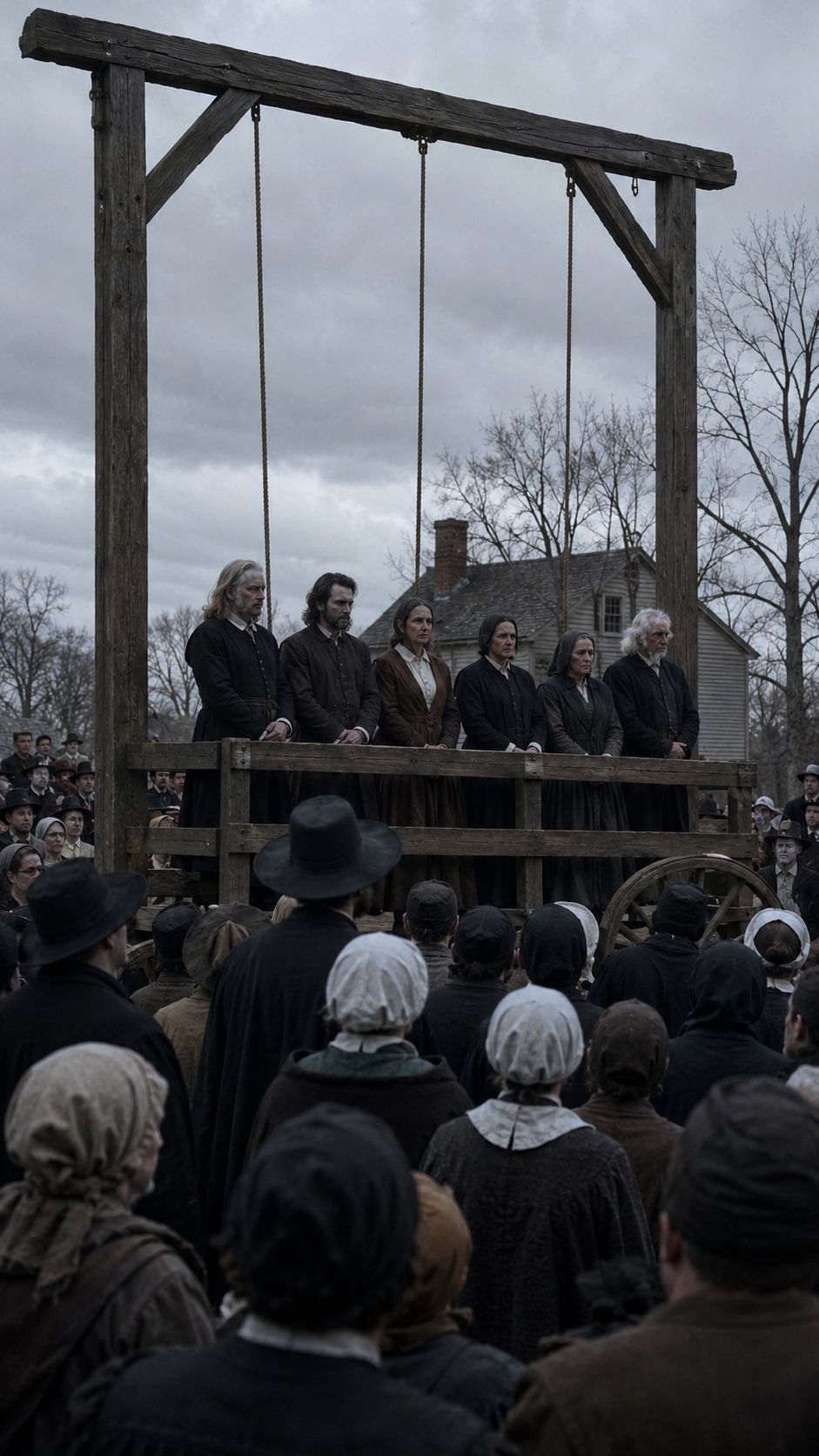
On 8 October 1789, Rachel Wall was hanged on Boston Common in front of a crowd of thousands. She was 29 years old. She was the last woman ever executed by the Commonwealth of Massachusetts.
History delivered its verdict soon after. Six years later, Massachusetts changed its law: unarmed robbery would no longer be a capital crime. Rachel Wall, William Smith, and William Dunogan were the last three people ever executed in Massachusetts for robbery. She was hanged for a seven‑shilling hat, six years before the state decided that nobody should hang for such a thing again.
Margaret Bender, the girl whose bonnet it was, lived to be 72. According to her own grandson, she never stopped deploring the fact that a life had been forfeited on her account. She carried it for fifty‑three years.
The relics are still here, and you can go to them. Boston Common — America’s oldest public park, where tourists eat lunch and children play — is the ground where they hanged her, and the site of the old gallows is still marked in the park. And Rachel’s actual confession, the broadside printed by her jailers the night before her death with a crude woodcut of three figures hanging on the Common, survives in the collection of the American Antiquarian Society. You can read her own words, dictated in a cell, about the man who ruined her and the hat she swore she never took.
Nearby on the Dark Atlas
- The Quaker Who Hung Like A Flag
Puritan Boston hanged a Quaker woman as a warning, and the wind turned her execution into the opposite of what they intended.
Boston, United States · 1660 · same site
 The First to Hang at Salem
Convicted on nothing but a dream of her spectre, she was the first person executed in the Salem witch trials.
Salem, Massachusetts, United States · 1692 · 22 km away
 The Killing Ground of Salem
A colonial village turned mass hysteria into mass execution, hanging dozens on a single barren ridge.
Salem, Massachusetts, United States · 1692 · 22 km away
- The Enslaved Woman Who Started the Salem Witch Trials
Her confession to save herself named two other women as witches, setting off accusations that would kill twenty people.
Salem, United States · 1692 · 22 km away
More like this
- The Murder Dickens Turned Into Fiction
A cold, calculated murder buried a body in a Bermondsey kitchen, and became fodder for the country's most famous novelist.
Bermondsey, London, United Kingdom · 1849
- The Chair No One Is Allowed To Sit In
A murderer's cursed armchair now hangs on a museum wall, five feet off the ground, so no one can sit in it again.
Thirsk, United Kingdom · 1702
- The Poisoner Who Weaponised A Town's Sweet Shops
She poisoned an entire town's confectionery to disguise the murder of a woman she hated, killing a child she never met.
Brighton, United Kingdom · 1871
 The Rape Trial That Ended In Trial By Combat
A woman's accusation of rape led to France's last judicial duel, with her own life staked on the outcome.
Paris, France · 1386