The Crying Boy is the most famous cursed object in modern British folklore, and almost nothing about the curse survives contact with the record. It was a cheap, mass-produced print of a weeping child, the sort of sentimental picture that hung harmlessly above ten thousand gas fires, until one week in the autumn of 1985 when a tabloid newspaper decided it caused house fires and could not itself be burned. What followed was a genuine national panic, six weeks long, ending in a bonfire on waste ground near Reading. It is a story about grief and superstition, certainly, but far more about how a newspaper manufactures a monster, and how the rational explanation offered at the time was reported so quietly that hardly anyone heard it.
To understand it you have to picture the British high street of the 1960s and 70s. Department stores and market stalls across the country sold sentimental prints of tearful, wide-eyed children by the crate, painted with a heavy photographic pathos. The most famous was the weeping boy signed “G. Bragolin”. Clarke’s research puts an estimated fifty thousand of these prints into British homes, sold particularly through department stores in the working-class districts of northern England, with one account claiming a quarter of a million. Even these figures are estimates rather than sales records. And there was never only one crying boy: some of the pictures caught up in the panic were not Bragolin’s at all but the work of the Scottish painter Anna Zinkeisen, who died in 1976, from a series called Childhood. For a quarter of a century nobody thought anything of any of them.
The Horror
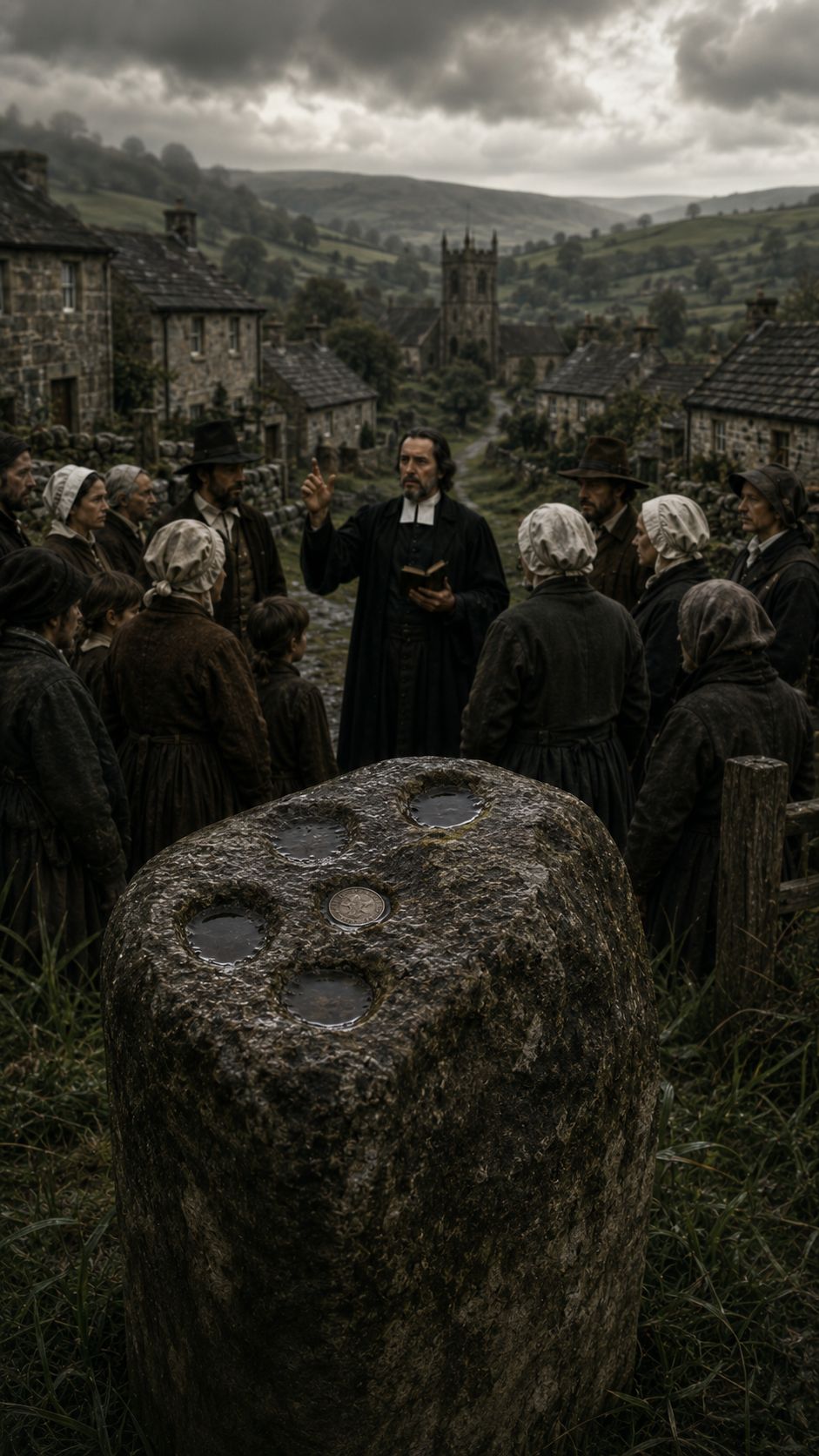
On the 4th of September 1985, Britain’s biggest-selling newspaper ran the headline “Blazing Curse of the Crying Boy”. The story concerned Ron and May Hall of Rotherham, in South Yorkshire, whose council house had been gutted by a fire that began, mundanely, with a chip pan in the kitchen. The blaze tore through the downstairs rooms. The framed print of the Crying Boy came through it undamaged. That alone was a small oddity, worth a paragraph at most, and what turned it into a curse was the family connection: May Hall’s brother-in-law Peter, Ron’s brother, was a firefighter, and he told the paper he knew of other fires where the same print had been found intact in the ruins. He said he had come to dread the sight of it. He said he had warned them to get rid of it.
The effect was immediate and it was cultivated. The following day The Sun reported that horrified readers had flooded the paper with calls telling the same story: the house burned, everything went, the boy on the wall survived without a mark. Under the editorship of Kelvin MacKenzie the paper ran a campaign for roughly six weeks, follow-up after follow-up, “Crying Boy Curse Strikes Again”, each instalment printing fresh reader testimony and deepening the fear. People threw their prints out. Some were too frightened to take them down themselves. A picture that had hung innocently over ten thousand fireplaces had become, inside a fortnight, the most feared object in the country.
What the campaign had far less room for was the fire service. Station Officer Alan Wilkinson, a man with thirty-three years in the job, had personally logged around fifty crying-boy fires going back to 1973 — and it is worth being precise about this, because the figure is routinely misattributed to Peter Hall and used as evidence for the curse. Wilkinson’s fifty cases were a record of how many ordinary house fires had happened to contain an extremely common print, and he dismissed any supernatural reading of them outright, attributing the fires to human carelessness. Chief Divisional Officer Mick Riley put the service’s position flatly: “fires are not started by pictures or coincidence, but by careless acts and omissions.” Fire officers also gave the structural answer in 1985, years before anyone tested it — the print was produced on high-density hardboard, which is very difficult to ignite. South Yorkshire Fire Service issued a public statement assuring people the pictures were harmless. It made no headline of comparable size.
The sinister origin story that now travels with every retelling was not part of the 1985 panic at all. The tale of a Spanish orphan called Don Bonillo, whose parents died in a fire, around whom blazes followed until he was nicknamed “Diablo”; of the priest who warned the painter to have nothing to do with the cursed child; of the artist ignoring the warning, the boy vanishing, the studio burning and the painter ruined — that story appears to enter print in 2000, fifteen years later, presented as fact in Tom Slemen’s Haunted Liverpool 4. Clarke went looking for its foundations and found none. Neither Don Bonillo nor “George Mallory”, the researcher who supposedly uncovered him in 1995, can be traced in any record. Clarke’s judgement is that there is no truth whatsoever in any of it. The story goes that the painter’s model was a cursed child; no record supports the claim, and the legend is fifteen years younger than the panic it is used to explain.
The Modern Relic
The paper that raised the panic closed it with a spectacle. The Sun invited frightened readers to send their prints in to be destroyed — “if you are worried about a crying boy picture hanging in your home, send it to us immediately” — and the prints came. Clarke’s account has the Bouverie Street offices swamped, the Crying Boys stacked twelve feet high, around two thousand five hundred of them collected. On Halloween 1985 the reporter Paul Hooper took two van loads to waste ground near Reading, alongside Page Three models, poured on kerosene and lit it, and the paper declared the curse nailed for good. An entire nation had been persuaded to ritually burn its own living-room art, and the only fire the Crying Boy can be shown to have caused was the one deliberately lit to destroy him.
The debunking deserves the same scepticism as the curse, because parts of it are firmer than others. Three things are documented. The painter was real and unremarkable: Bruno Amadio, who signed as Giovanni Bragolin, an academically trained Italian born in Venice on the 9th of November 1911 and dead in Padua on the 22nd of September 1981, a painter and restorer in post-war Venice who turned out at least sixty-five weeping children under the Bragolin name and was found in the 1970s alive, comfortable and still working — not a man ruined by a curse, though he was reportedly poorly served on royalties as his images were reproduced worldwide. There is a real disagreement in the sources here: Clarke and others describe Amadio as Spanish, which may be the Spanish orphanage legend bleeding backwards into the biography, while the encyclopaedic account gives him as Venetian. The third pseudonym attached to him, “Franchot Seville”, is as untraceable as Don Bonillo. Second, the hardboard point stands, and it came from working fire officers in 1985. Third, the arithmetic is unanswerable: with fifty thousand of these prints in British homes, and house fires running into the tens of thousands a year, prints surviving fires is not a coincidence requiring explanation but a statistical certainty.
The most-quoted part of the explanation is the softest. In 2010, twenty-five years on, the BBC Radio 4 programme Punt PI took the question up, and Steve Punt, with the fire researcher Martin Shipp, tried to burn a Crying Boy. The print resisted. What burned readily was the string it hung from — and a picture whose string burns through falls face-down on the floor, where the board shields the image from the worst of the heat. That much they observed. The fire-retardant varnish that is now stated everywhere as the solution to the mystery was an inference drawn from the test rather than a laboratory finding about the printing process, and it should be reported as what it is: a plausible proposed mechanism, not an established fact. The honest position is that the board, the fallen frame and the sheer number of prints are sufficient on their own, and the varnish is a maybe.
There is a deeper hole beneath all of it. Almost every individual survival story rests on a reader’s recollection, gathered by a newspaper actively soliciting them, at the height of a panic it had created, with no independent record of what was in the room or how much of it burned. The fire service has the fires; nobody has the prints. The strange fact at the centre of the legend was never as well evidenced as either the curse merchants or the debunkers have needed it to be.
And the prints endure. They turn up in charity shops and car boot sales and online auctions, four decades on, and they still carry the reputation — sought out by some collectors precisely because of it, refused house room by others. A survivor of the 1985 bonfire is a genuine relic you can hold, of one of the strangest media panics of the twentieth century. The real curse of the Crying Boy was the story: a chip pan, a firefighter’s uneasy hunch, a brother-in-law’s warning and a tabloid campaign, combining to convince a country that a cheap picture of a weeping child could burn its houses down. He never started a single fire. For one strange autumn he was the thing Britain feared most.