Joseph Haydn was one of the titans of classical music — the “father of the symphony,” teacher of Beethoven, friend of Mozart, and the most famous composer in Europe in his day. When he died in Vienna on the 31st of May 1809, at the age of 77, the city was under siege by Napoleon’s army. Such was Haydn’s fame that Napoleon himself is said to have posted a guard of honour outside the dying composer’s house. With the war raging and Vienna occupied, Haydn was given a modest, hurried funeral and buried in a local cemetery. His body would remain undisturbed for a grand total of about eight days.
THE HORROR This was the golden age of a pseudoscience called phrenology — the belief, now completely discredited, that the bumps and contours of a person’s skull revealed their intelligence, character, and talents. Its followers were obsessed with getting hold of the skulls of geniuses to prove their theory, and there was no greater prize than the head of a musical genius, in which they were certain they would find a well‑developed “bump of music.”
Two men were determined to have Haydn’s. One was Joseph Carl Rosenbaum, a former secretary to Haydn’s aristocratic employers; the other was Johann Nepomuk Peter, a prison governor and amateur phrenologist. Just days after the funeral, they bribed the gravedigger, crept back to the cemetery, dug up the composer, and sawed off his head. The body had already begun to decompose in the June heat, and the stench was so appalling that Rosenbaum vomited in his carriage as he carried the head away.
They took the head, stripped it of flesh, removed the brain, and bleached the skull white. Then they examined it and triumphantly declared that yes — Haydn’s skull showed a fully formed “bump of music,” proving their theory. Satisfied, they placed the great composer’s polished skull in a beautiful custom‑made black box, fitted with glass windows, a white silk cushion, and a golden lyre on top, and kept it as the crown jewel of a private collection.
And for eleven years, nobody knew. Haydn lay in his grave, headless, while his skull sat in a box in a Viennese apartment being shown off to visitors.
THE MODERN RELIC The theft only came to light in 1820, when Haydn’s former patron, Prince Nikolaus Esterházy, finally arranged to move the composer’s remains to a grand tomb at the family seat in Eisenstadt. The grave was opened — and there lay Haydn’s skeleton, with his burial wig resting neatly on top of the bare vertebrae of his neck. The head was gone.
The enraged prince called in the police, who quickly identified the culprits. And here the story turns into pure farce. When the authorities came, the thieves refused to give up their treasure. They handed over a substitute skull — the wrong one, belonging to some young stranger. When that was rejected and the house was searched, Rosenbaum hid the real skull inside a straw mattress, and had his wife lie on the bed pretending to be gravely ill, knowing the police would never dream of asking a sick lady to get up. The trick worked. The searchers left empty‑handed.
Eventually the pair handed over yet another substitute skull to satisfy the prince — and it was this fake, anonymous skull that was solemnly buried with Haydn’s body in the magnificent Eisenstadt tomb. Meanwhile, the real skull began a bizarre 145‑year odyssey, passed from owner to owner, doctor to doctor, until it ended up in a glass case, displayed on a piano, in the keeping of Vienna’s Society of the Friends of Music.
The reunion took over a century to arrange, delayed at every turn — and made almost impossible when, after the Second World War, Haydn’s body ended up in the Soviet occupation zone while his skull sat in the international zone of divided Vienna. Finally, in 1954, the skull was blessed by the Archbishop of Vienna, carried in a hearse to Eisenstadt, and, 145 years after it was stolen, at last laid to rest with the rest of Haydn’s body.
But there is one final, perfect twist. When they reunited Haydn with his real skull, no one removed the fake substitute skull that had been buried with him all those years. It was simply left in place. And so, to this day, the tomb of Joseph Haydn in the Bergkirche in Eisenstadt — a beautiful marble sarcophagus you can visit right now — contains two skulls. One is Haydn’s. The other belongs to a total stranger whose name no one will ever know, resting for eternity in the tomb of a genius, honoured since 2008 with a small plaque to “the skull of the unknown person.”
Nearby on the Dark Atlas
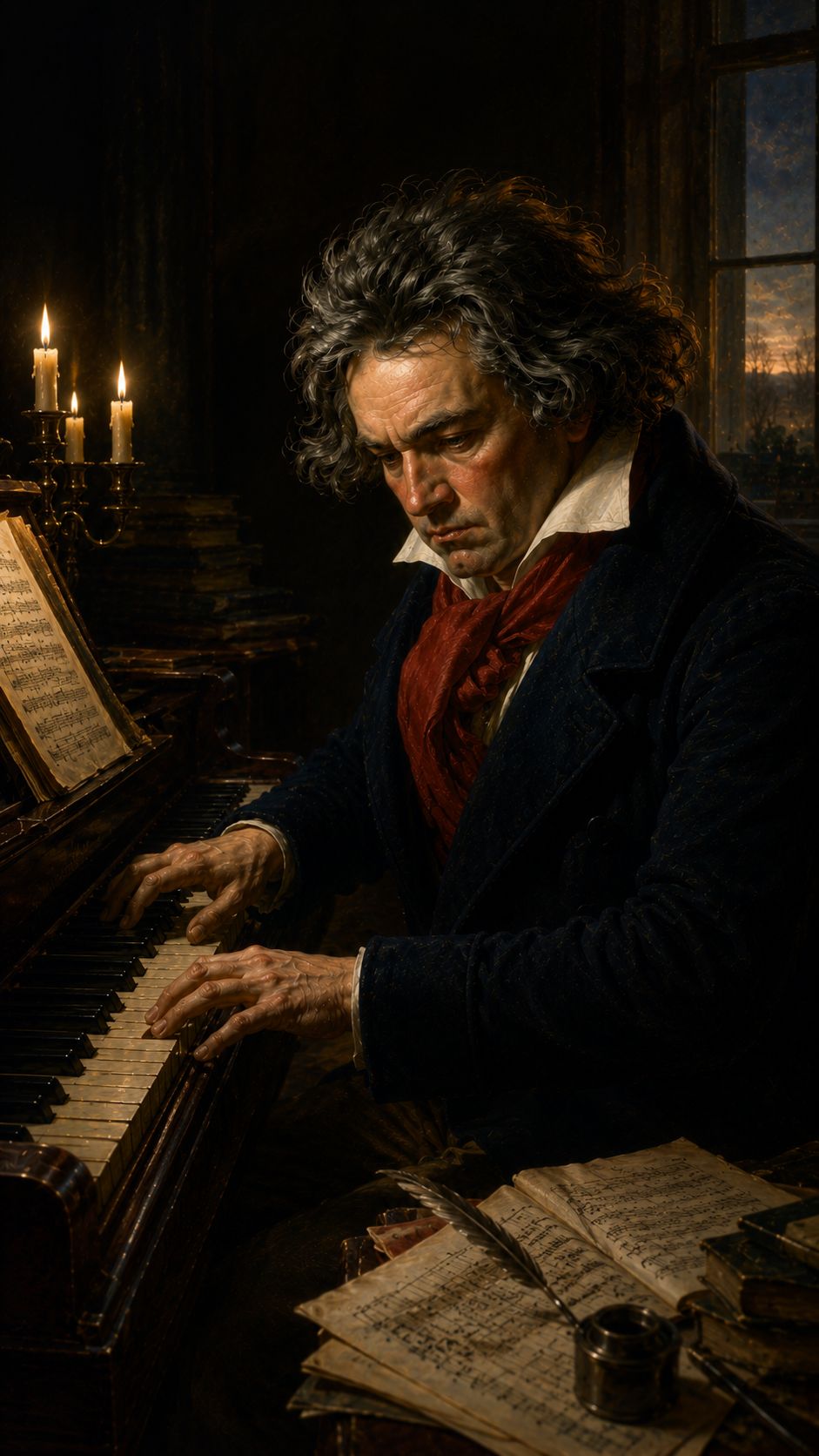 The Composer Whose Skull Was Stolen
A genius conceals his encroaching deafness for years, and even after death, souvenir hunters aren't done taking pieces of him.
Vienna, Austria · 1827 · same site
 The Doctor Who Discovered Handwashing Too Late
A Vienna doctor works out why women are dying of childbed fever in droves, and nobody in power wants to believe him.
Vienna, Austria · 1847 · same site
- The Man Bambi's Success Could Not Save
The gentle author behind Bambi became one of the countless writers erased and exiled by the Nazis he had once tried to outrun.
Vienna, Austria · 1938 · same site
 The Composer Buried In An Unmarked Grave
The man who wrote The Magic Flute and an unfinished Requiem was given the cheapest funeral money could buy.
St Marx Cemetery, Vienna, Austria · 1791 · 3.4 km away
More like this
- The Leper King's Story No Film Would Show
Kingdom of Heaven gave him a dignified death behind a silver mask, the truth was far crueller.
Jerusalem, Israel · 1185
 The Rape Trial That Ended In Trial By Combat
A woman's accusation of rape led to France's last judicial duel, with her own life staked on the outcome.
Paris, France · 1386
- The Parish Registers Of The Beast's Victims
Between 1764 and 1767 something killed roughly a hundred people, recorded in the registers as 'devoured by the beast.'
Saugues, France · 1764
- The Manufacturing Of England's Most Haunted House
For decades it was called the most haunted house in England, until its ghost story revealed how a haunting gets made.
Borley, Essex, United Kingdom · 1929