
In the 6th century BC, a bronze‑worker named Perillos of Athens travelled to the court of Phalaris, tyrant of Akragas in Sicily, with a gift he believed would make his fortune.
He had designed a device: a hollow bull cast in bronze, life‑sized, with a door in the flank. A person could be placed inside. A fire would be lit beneath the belly. The bronze would heat. The person inside would roast.
But the detail that made Perillos proud — the innovation he believed elevated his work from mere cruelty to artistry — was the acoustic system. Tubes and stops were built into the bull’s head so that the screams of the person inside would be channelled through the pipes and emerge from the mouth transformed — converted into the bellowing of a living animal.
The executioner would hear “music.” The crowd would hear a bull. The victim would hear nothing but their own voice, distorted beyond recognition, coming back through bronze.
Perillos presented the device to Phalaris. He explained the engineering. He demonstrated the acoustics. He was proud.
Phalaris said: let’s test it.
THE HORROR Perillos was seized by Phalaris’s guards and forced into the bull. The door was closed. The fire was lit.
The inventor of the Brazen Bull became its first victim.
His screams — filtered through the pipes he had designed, shaped by the acoustics he had calculated — emerged from the bull’s mouth as the bellowing he had promised. The system worked perfectly. The first sound the Brazen Bull ever produced was the voice of the man who built it, converted into the roar of an animal by his own engineering.
Later versions of the story differ on the details. Some say Phalaris ordered Perillos pulled out before he died — not out of mercy, but to keep the inventor alive long enough to understand exactly what he had created. Some say that once removed he was thrown from a cliff. Others say he died inside the bull.
Every version agrees on one point: the man who designed the device was the first to prove it worked.
Phalaris kept the bull. He used it extensively, roasting political enemies, criminals and anyone who displeased him. He became one of the most feared rulers in the Greek West. The bull became his signature: the sound of screaming turned into animal noise became the soundtrack of his tyranny.
Then Akragas revolted. Phalaris was overthrown by opponents (one tradition names a general Telemachus). The new rulers looked at the bronze bull that had terrorised their city for years. They looked at the man who had used it.
They put Phalaris inside.
The tyrant who had burned men in the bull was burned in his own bull. The device that had given him power became the instrument of his death. The inventor was the first victim. The owner was the last.
THE MODERN RELIC Whether the Brazen Bull existed exactly as described is debated. Ancient authors like Diodorus Siculus and others mention it, but classical writers were not always literal chroniclers, and a hollow bronze bull with a tuned acoustic system does sit halfway between engineering and morality tale.
What is not in doubt is why the story has lasted more than 2,500 years: its structure is perfect. The inventor is destroyed by his invention. The tyrant is destroyed by his tyranny. The machine that converts human suffering into spectacle is the same machine that converts power into punishment.
The bull consumes everyone who touches it — the man who makes it, the man who uses it, and every person locked inside it in between.
No confirmed Brazen Bull has ever been found by archaeologists. If one ever existed, it would have stood somewhere in ancient Akragas — modern Agrigento in Sicily — a city whose Greek temples still rise on a ridge above the Mediterranean. Tourists visit the Valley of the Temples. They photograph columns against the sky.
They do not see a bull. The story does not need bronze. The image of a scream turned into a bellow has been echoing on its own for millennia.
Nearby on the Dark Atlas
- The Bull That Sang With Human Screams
A bronze bull was built to turn a dying man's screams into music for the crowd.
Agrigento, Italy · 550 BC · same site
- The Bull That Turned Screams Into Bellows
Tubes built into its bronze head disguised a burning man's screams as the roar of an animal.
Agrigento, Italy · 560 BC · same site
- The Sleeping Beauty Who Never Decayed
A grieving father had his two-year-old daughter embalmed with a secret formula — a century later she still looks asleep.
Palermo, Italy · 1920 · 91 km away
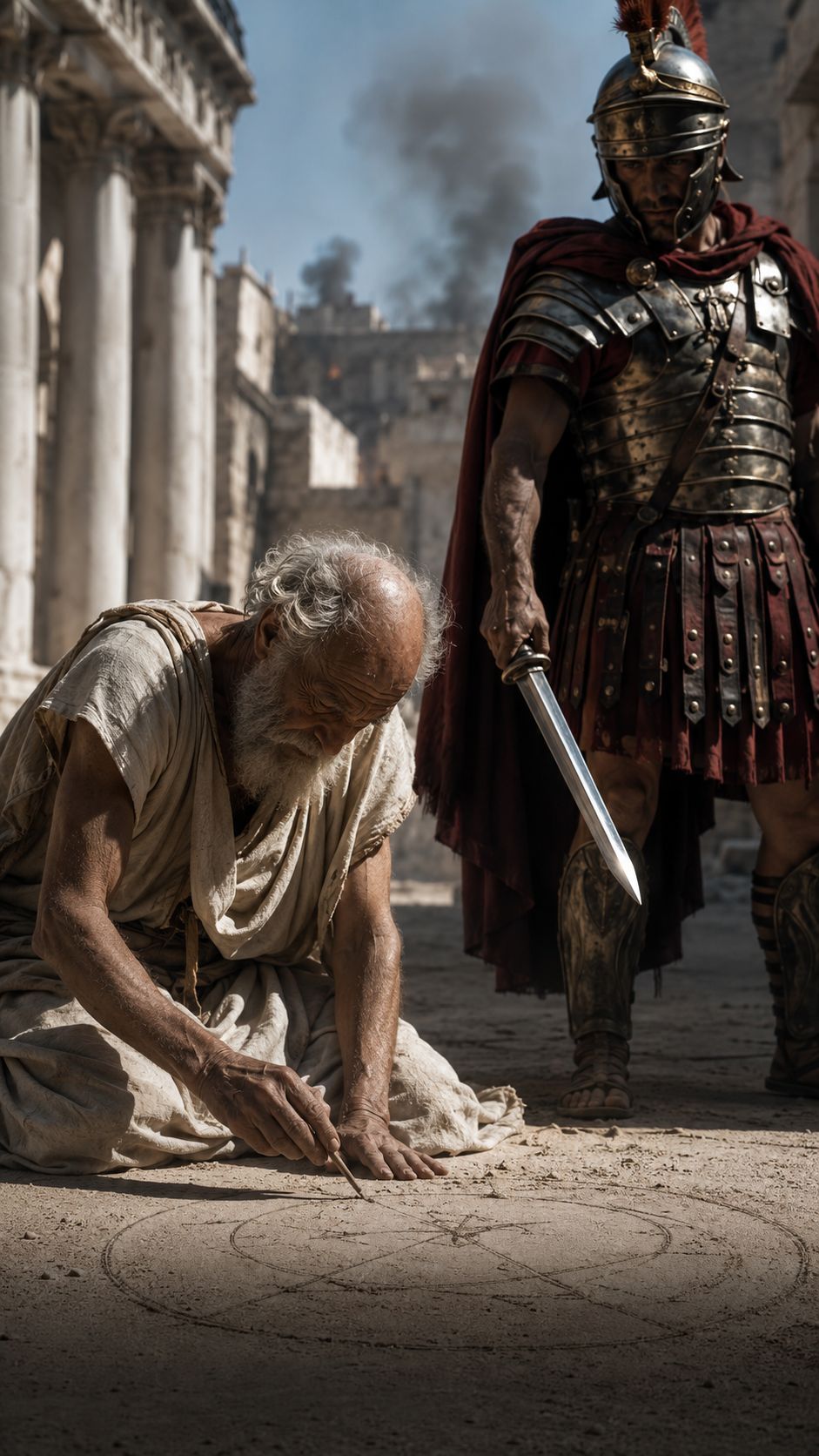 Killed Over A Drawing In The Sand
Rome's soldiers finally broke into Syracuse, and its greatest mind died mid-calculation, refusing to abandon his diagram.
Syracuse, Italy · 212 BC · 154 km away