
Anne Greene is one of the most extraordinary figures in the history of English medicine — a young servant woman who was hanged, beaten, sealed in a coffin, and delivered to a room full of anatomists with knives already laid out. And who, when they opened the lid, was found to be alive.
To understand what happened to her, you have to understand the law that killed her. Anne Greene was about twenty-two, a servant in the household of Sir Thomas Read at Duns Tew in Oxfordshire. She was seduced by Read’s grandson, Geoffrey, and became pregnant. She concealed it. At roughly seventeen weeks she miscarried in the house privy — the infant was tiny, undeveloped, and certainly incapable of surviving. She hid the body. Under an act of 1624, that concealment was, by itself, enough. The law held that any unmarried woman who hid the death of her infant was presumed to have murdered it, and the burden fell on her to prove otherwise. Anne Greene could not. She was tried at the Oxford assizes, convicted of infanticide, and sentenced to hang.
The Horror
On 14th December 1650, she was taken to the gallows in the yard of Oxford Castle. She was turned off the ladder, and then the crowd did what crowds did in an age before the long drop — when strangulation was slow, mercy meant force. Her friends pulled down on her legs with their full weight. Some lifted her bodily and let her fall with a sudden jerk to break her neck. A soldier standing by struck her repeatedly in the chest and stomach with the butt of his musket. She hung for around half an hour. Then she was cut down, declared dead, and put into a coffin.
The body was carted to the house of an Oxford apothecary named Clarke, because Anne Greene had been given to the university’s anatomists for public dissection — the standard fate of an executed criminal. Waiting for her were two young physicians named Thomas Willis and William Petty, both of whom would go on to become founding figures of the Royal Society, and one of whom would give his name to the circle of Willis in the human brain.
They opened the coffin. And they heard a rattle in her throat.
What happened next is recorded in an eyewitness pamphlet printed within weeks. A bystander — thinking he was ending her suffering — stamped repeatedly on her chest and stomach with the full force of his body. Willis and Petty stopped him, abandoned the dissection entirely, and instead began, with the crude tools of seventeenth-century medicine, to try to bring her back. They forced hot cordial into her mouth. They rubbed and chafed her arms and legs to move the blood. They tickled her throat with a feather. They bled her of five ounces. They wrapped her in heating plasters, applied clysters, and put her into a warm bed with another woman lying beside her for body heat. Within about an hour, her eyes opened. Within twelve hours, she spoke. Within four days she was eating; within a month she was walking. She had no memory of the hanging at all — the last thing she could recall was standing at the foot of the ladder.
The Modern Relic
The reaction was not medical. It was theological. Seventeenth-century Oxford concluded that God had overturned the verdict, and the argument for mercy was overwhelming: the infant had been so premature that it could never have drawn breath, meaning there had been no murder to conceal in the first place. Sir Thomas Read — the man whose family had employed her, and who had driven the prosecution — died within three days of the execution, which the city took as a further sign. Anne Greene was granted a reprieve and then a pardon.
She did not hide afterwards. Crowds came to see the woman who had come back, and money was collected from the visitors to support her. When she finally left Oxford for the countryside, she took her own coffin with her. She married, had three children, and lived roughly another nine years — an ordinary life, carried out by a woman who had legally already died.
The relic is the paper trail and the stone. Her case was written up in 1651 in a pamphlet titled Newes from the Dead, printed in Oxford, complete with commemorative verses by university scholars — among them a young Christopher Wren, decades before he designed St Paul’s Cathedral. Copies survive in the Bodleian Library. The physicians who revived her went on to help found the Royal Society, and their treatment of Anne Greene is still cited as one of the earliest documented resuscitations in English medical history. And Oxford Castle still stands in the centre of the city — now open to visitors, its mound and tower and prison yard intact. You can walk through the ground where a woman was hanged for half an hour, beaten with a musket, nailed into a box, and delivered to the anatomists — and then got up, went home, and outlived nearly everyone who watched her die.
Nearby on the Dark Atlas
 The Bishop's Candle That Lit The Reformation
Burning at the stake beside a fellow bishop, he promised their deaths would light a candle that could never be put out.
Oxford, United Kingdom · 1555 · same site
- The Candle That Would Never Be Put Out
Burned together for their faith, one died quickly while the other screamed in agony for nearly an hour.
Oxford, United Kingdom · 1555 · same site
 The Empress Who Escaped Through The Snow
Trapped in a besieged castle, England's rightful heir was lowered by rope into a snowstorm in white and walked to freedom.
Oxford Castle, Oxford, United Kingdom · 1142 · same site
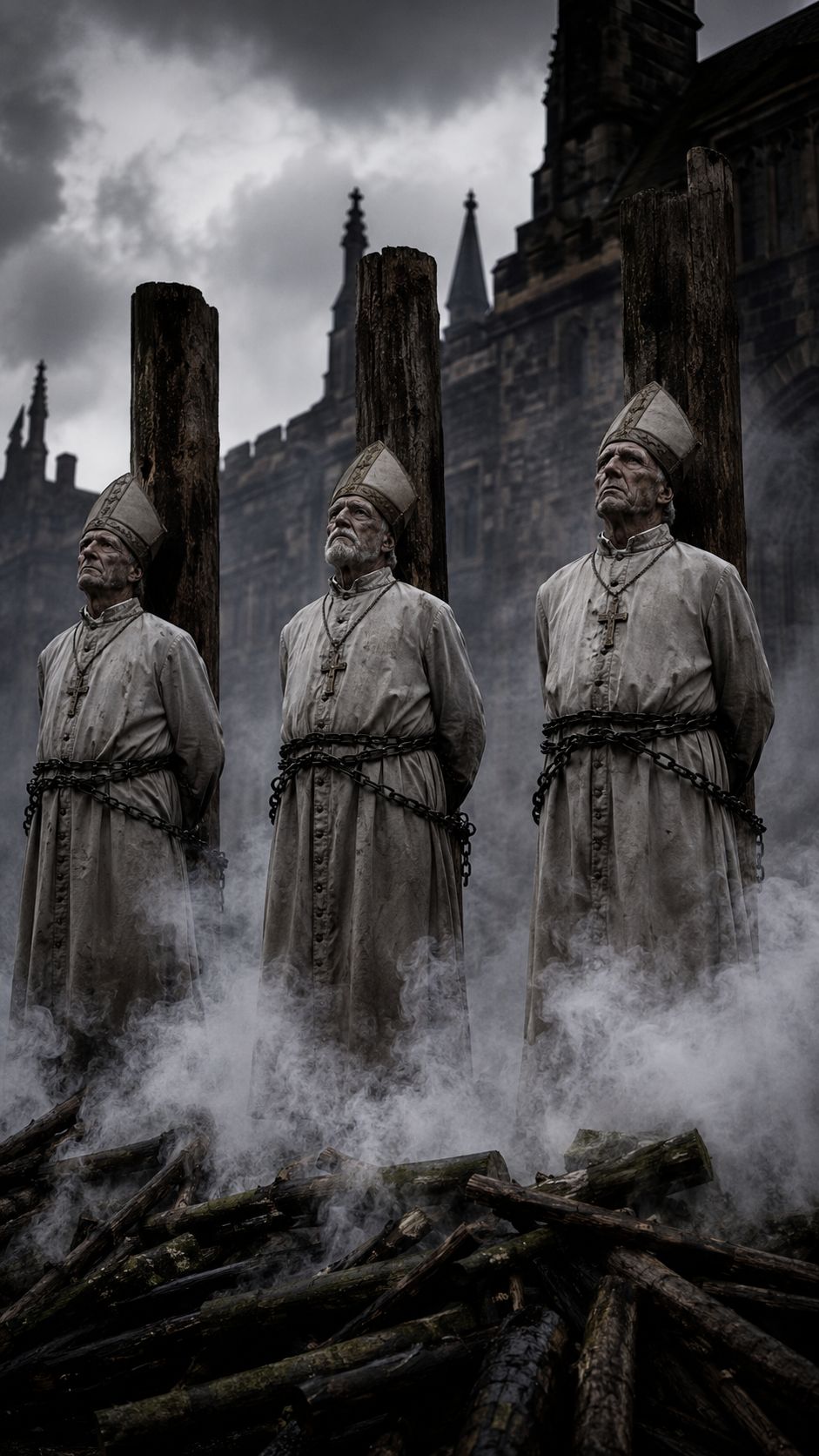 The Fires That Made Bloody Mary's Name
Three of England's highest churchmen were chained to stakes in the center of Oxford and burned before a watching crowd.
Oxford, United Kingdom · 1555 · same site