
Under English law, the statutory punishment for high treason was hanging, drawing, and quartering. But that full sentence was only for men. For women convicted of high or petty treason, the law prescribed a different ritual: they were to be drawn to the place of execution and burned at the stake.
The stated reason was “decency.” Dismembering a female body in public and displaying it was considered an intolerable outrage to modesty. Burning her to death with her clothes pinned on was considered less offensive to spectators’ sensibilities.
Burning remained on the statute book until the Treason Act of 1790. Catherine Murphy’s execution, one year earlier, forced Parliament’s hand.
The Horror
On 18th March 1789, Catherine Murphy was led from the debtors’ door of Newgate Prison in London. She walked past the hanging bodies of her husband Hugh and seven other men, all executed moments earlier for the same crime: coining — counterfeiting, classed in law as a form of treason.
The eight men were hanged in the usual way. Catherine, as a woman, could not be quartered. Instead, she was taken to a small platform — about ten inches square, one foot high — set in front of a wooden stake. She was fastened to the stake with ropes and an iron ring around her body.
Since the 1650s, practice in London had been to strangle women before the fire was lit, to avoid burning them alive. Sir Benjamin Hammett, the Sheriff of London who supervised Murphy’s execution, later testified that he had ordered the noose to be tightened and the platform pulled away, leaving her hanging for around half an hour before the faggots were set alight.
Her body was then burned. Residents around Newgate — merchants, lawyers, “respectable” City tradesmen — complained about the smell of burning flesh drifting into their homes and shops, as they had three years earlier when another woman, Phoebe Harris, was burned there for coining.
Catherine Murphy was the last woman in England to be officially sentenced to burning at the stake. She was not the worst case.
In 1726, Catherine Hayes was executed at Tyburn for the murder of her husband. Following custom, the executioner attempted to strangle her with a cord passed through a hole in the stake before the flames reached her. The fire was lit too soon and drove him back; the rope burned through. Hayes was seen struggling in the flames, shrieking three times and trying to push away the burning faggots with her hands before a heavy piece of wood was thrown at her head, smashing her skull.
Sixty‑three years separated Hayes and Murphy. In between, Parliament did not change the law.
What finally did change it was the reaction of men like Hammett, who had to stand beside the stake. In 1790, as Member of Parliament for Taunton as well as former Sheriff, he introduced a bill to abolish burning for women and replace it with hanging. The Treason Act 1790 received royal assent on 5th June. From that date, women convicted of high or petty treason were to be drawn to the place of execution and hanged, not burned.
It took Parliament fourteen months after Catherine Murphy’s execution. Her case is explicitly cited in accounts of the debate.
The Modern Relic
The Old Bailey — London’s Central Criminal Court — now stands on the exact site of Newgate Prison. The debtors’ door where Murphy emerged was roughly where a side entrance opens onto a quiet City street used by office workers and jurors.
The burnings took place in the open space just outside those walls, where the smell in 1786 was bad enough for neighbours to petition the Lord Mayor — not because they objected to burning women, but because the odour was bad for trade.
Today, people walk to St Paul’s, buy sandwiches, or hurry for trains over the same ground. There is no plaque to say that this pavement once hosted a stake, that women were tied to it in the name of modesty, and that a law changed only when it became embarrassing.
Nearby on the Dark Atlas
- The Monks Starved in the Dark
Refusing to bow to the King, ten monks were chained upright in darkness and left to waste away.
Newgate Prison, London, United Kingdom · 1537 · same site
 The Thief Who Escaped His Own Execution Cell
Chained to the floor of a condemned cell with hours to live, he picked his way out with a crooked nail.
Newgate Prison, London, United Kingdom · 1724 · same site
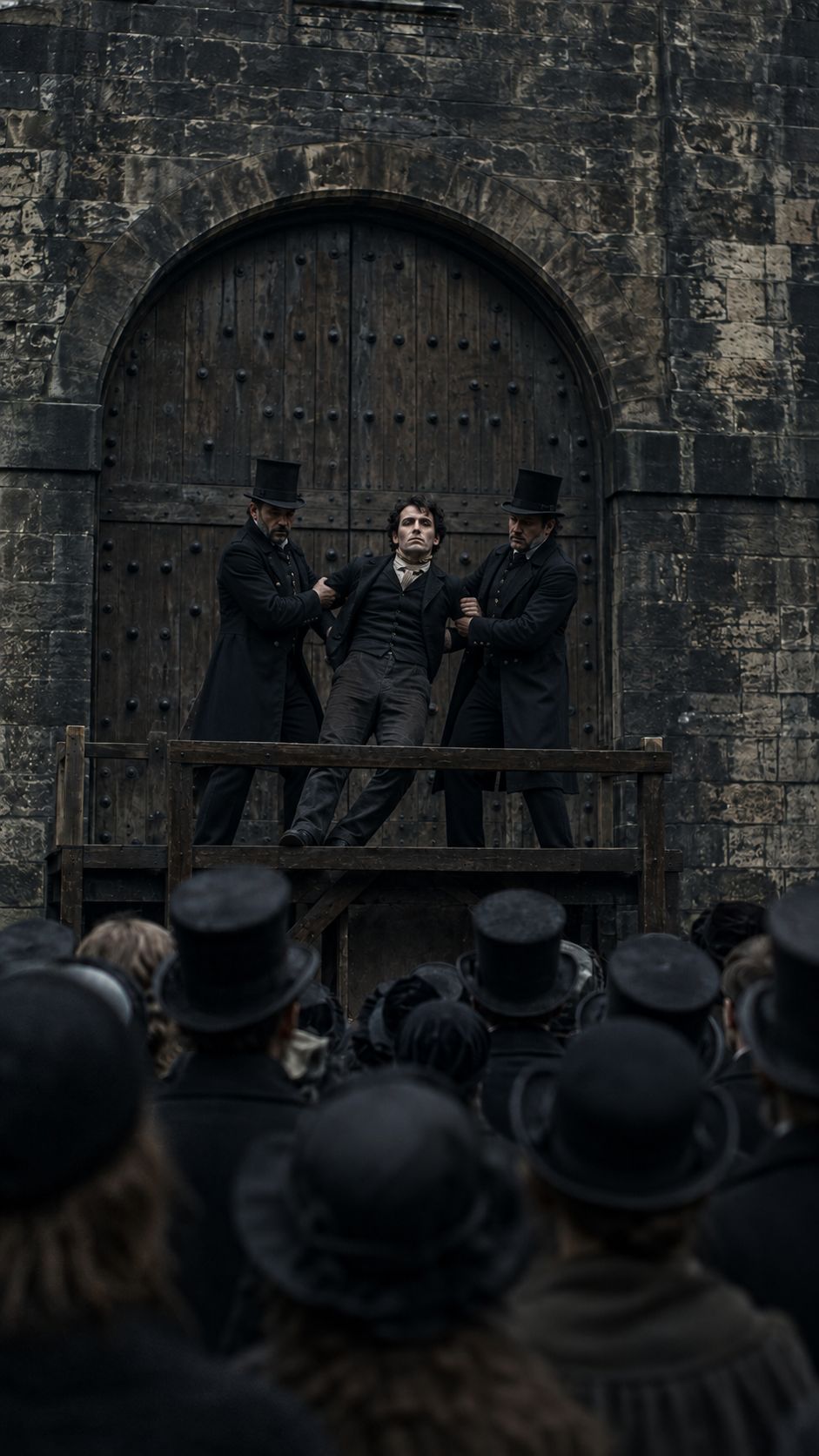 The Last Man Hanged In Public In England
A crowd of two thousand gathered outside a London prison to watch him hang — the last time that would ever legally happen in England.
London, United Kingdom · 1868 · same site
 The Prophet Who Warned a King
She told Henry VIII he would die within months if he married Anne Boleyn — and paid with her own head instead.
London, United Kingdom · 1534 · same site