Ivan IV of Russia earned his name. The first Tsar of all Russia, he built an empire, but by his final years he had descended into paranoia and uncontrollable rage, torturing and executing thousands, and carrying with him everywhere a long, heavy staff tipped with sharpened iron. In November 1581, in his palace at Alexandrov, that staff killed the one person he could not afford to lose: his own son and heir.
THE HORROR According to the account most historians accept, it began over something almost trivial. Ivan came upon his son’s wife, Yelena — who was pregnant — and decided she was dressed immodestly, wearing too few layers for how a respectable woman should appear. In a fury, he beat her. The beating is believed to have caused her to miscarry, losing Ivan his unborn grandchild.
His son, the 27-year-old Tsarevich Ivan Ivanovich, was the only capable heir to the throne; his younger brother Feodor was gentle and considered simple-minded. When the young Ivan learned what his father had done to his wife and their child, he confronted him, raging, accusing him. It was one accusation too many.
The old Tsar swung his iron-pointed staff and struck his son in the head.
And then, in an instant, the madness broke. As blood poured from his son’s temple, the fury that had ruled Ivan drained away and was replaced by pure horror. He fell to the floor and gathered the dying young man into his arms, pressing his hands to the wound, trying to stop the bleeding he had just caused, wailing and begging God for help. He is said to have screamed for doctors, for miracles, for anything. Nothing came. His son lingered for several days, and then he died — forgiving his father, according to the story, even as his father’s blow killed him.
Ivan the Terrible had murdered not just his son, but the entire future of his dynasty, with a single swing of his arm.
THE MODERN RELIC The consequences were exactly as catastrophic as they sound. When Ivan died three years later, the throne passed to the feeble Feodor, the line soon collapsed, and Russia fell into the horror it remembers as the Time of Troubles — years of famine, false heirs, invasion, and chaos.
But the relic is the strangest part. Three centuries later, in 1885, the artist Ilya Repin painted that exact moment — the old Tsar on the floor, eyes bulging with dawning horror, cradling his blood-soaked dying son. It is one of the most psychologically devastating paintings ever made. Tsar Alexander III was so disturbed by it that he banned it from public view — the first painting ever censored in Russian history.
Then the painting itself seemed to become cursed. In 1913, a man walked up to it and slashed the faces of both Ivans three times with a knife, screaming “Enough death! Enough blood!” When the gallery’s curator learned his masterpiece had been mutilated, he threw himself under a train. The painting was restored — and then, in 2018, another man attacked it again, smashing it with a metal pole.
To this day, the painting hangs in the Tretyakov Gallery in Moscow, and to this day some Russians demand it be removed, insisting Ivan never killed his son at all. You can go and stand in front of it — the frozen instant a father realised he had just murdered his own child, an image so powerful that, four hundred years later, people are still trying to destroy it.
Nearby on the Dark Atlas
- The Father Who Killed His Own Heir
A single blow in a fit of rage killed his son and heir, and the moment was later painted so disturbing a man attacked it with a knife.
Alexandrov, Russia · 1581 · 1.0 km away
- The Night Stalin Silenced His Own Poets
Thirteen of the Soviet Union's greatest Jewish writers were led into a basement and shot in a single night.
Lubyanka Prison, Moscow, Russia · 1952 · 99 km away
- The Cossack Rebel Torn Apart In Red Square
He led the greatest rebellion the Tsars ever faced, and was taken apart alive before a silent crowd.
Red Square, Moscow, Russia · 1671 · 100 km away
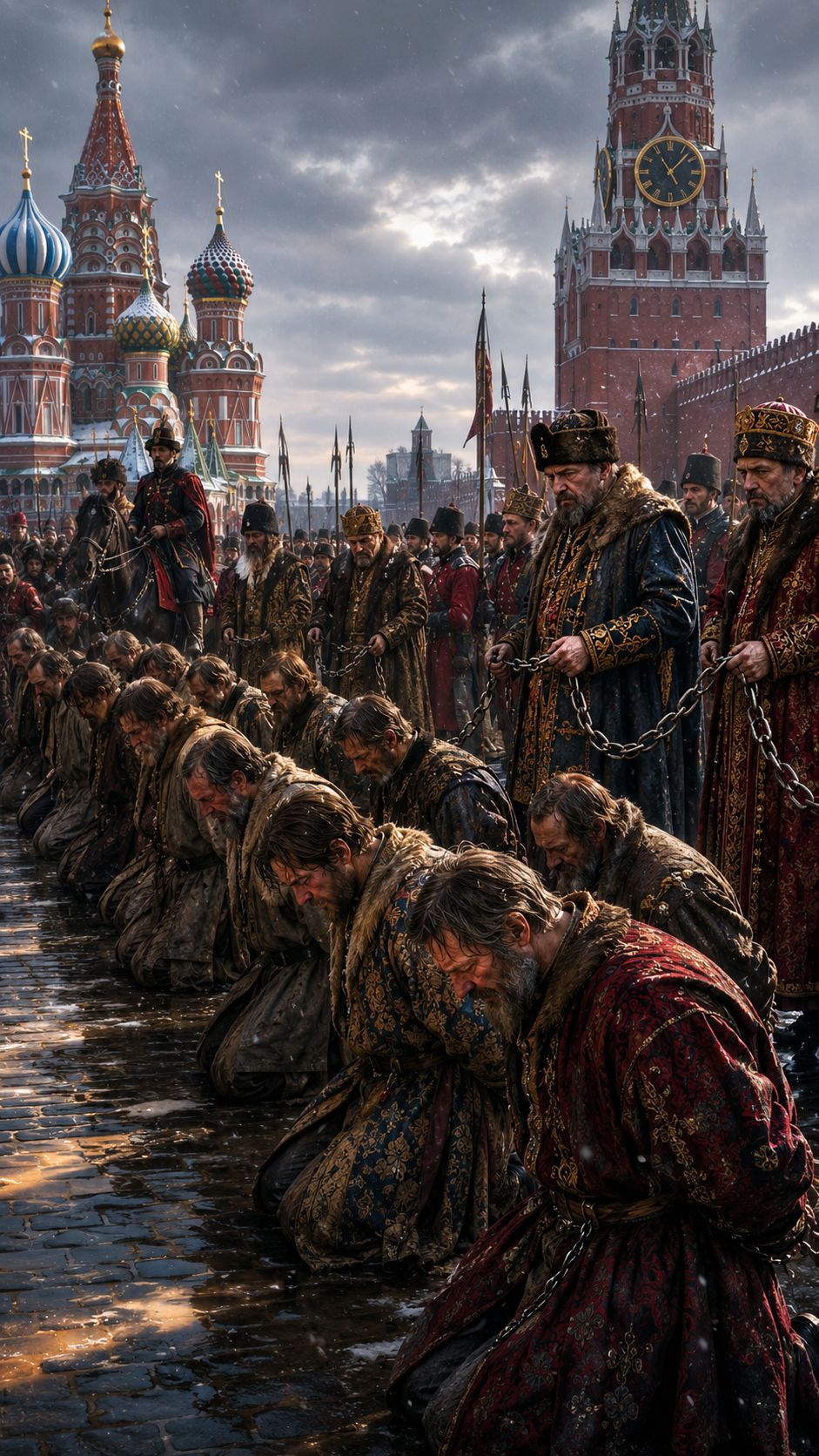 The Tsar Who Personally Executed His Own Guard
Two thousand rebel soldiers waited in Moscow, and the Tsar refused to let anyone else swing the axe.
Red Square, Moscow, Russia · 1698 · 100 km away