In January 1066, Edward the Confessor died without an heir, and three men decided England was theirs. Harold Godwinson took the crown. William of Normandy started building ships. And in Norway, the most feared warrior in Europe began to gather an army.
Harald Hardrada — “hard ruler” — was the last great Viking king. He was enormous, said to be near seven feet tall, and he had spent his entire life in war: exiled at fifteen, he’d fought his way across Russia, commanded the Byzantine Emperor’s Varangian Guard in Constantinople, fought in Sicily and the Holy Land, come home fabulously rich, and taken the throne of Norway. Now, at fifty‑one, he wanted England.
He sailed with around 300 longships and roughly 9,000 men, joined by Tostig — King Harold’s own exiled brother, who wanted revenge. On 20 September they destroyed an English army at Fulford and took York. Nothing stood between them and the north of England.
Harald relaxed. King Harold, he knew, was 200 miles away on the south coast, watching for William. There was no possible threat.
THE HORROR What Harald didn’t know was that Harold Godwinson had just done something almost impossible. He had turned his army around and force‑marched it about 180 miles up the length of England in four days.
On 25 September, the Vikings were lounging at a place called Stamford Bridge, collecting hostages — spoils of a war they thought was already won. It was a hot day. Their chainmail was a day’s march away, back at the ships at Riccall. So was a third of their army.
Then the horizon filled with steel.
Harald, watching thousands of English banners appear out of nowhere, made a joke to hide his shock — remarking that the English king sat well in his stirrups for such a small man. It was bravado. He knew. His army was split in half, unarmoured, and completely surprised.
The English smashed into the Norse scouts on the west bank and cut them apart. The survivors ran for the narrow wooden bridge over the River Derwent, with the whole English army behind them. On the far bank, Harald was frantically trying to form a shield wall — but he needed time, and he didn’t have it. Once the English were across that bridge, it was over.
And then one man turned around and walked back onto the bridge.
His name is not recorded. Not in any source, on either side. He was a Norse warrior with a great battle‑axe, and he planted himself in the middle of that narrow crossing and faced an army of thousands, alone, to buy his king the minutes he needed.
They came at him and he killed them. The bridge was so narrow that only one or two men could reach him at a time — and none of them could get past. They threw javelins at him and he shrugged them off. They came with swords and spears and he cut them down. The bodies began to pile up on the boards, which made it harder still for the next man to get to him. Some accounts say forty Englishmen died on that bridge.
The entire English army — the army that had just marched 180 miles in four days — was brought to a complete standstill by one man with an axe. On the far bank, the Norsemen were cheering him.
Nobody could beat him. So they cheated.
An English soldier found a barrel — some say a small flat‑bottomed boat — climbed inside, and let himself drift silently down the river until he was directly underneath the bridge. Then he looked up at the old wooden boards above his head, found a gap between them, took his spear, and drove it upwards with everything he had.
A mail shirt in 1066 was cut like a long skirt, protecting the body down to the knee. It protected absolutely nothing from below. The spear went up through the boards and into the one place the Viking had no defence at all, and the man who had held back an army folded onto the bridge he had refused to give up. The English poured across him and finished him.
And then they hit the shield wall. The fighting went on into the dusk and it was savage. But the Vikings had no armour on a hot day, and it decided everything: as Harald Hardrada raged through the English lines, an arrow found his bare throat, and the last great Viking king of Europe went down like a felled tree. Tostig was offered peace by his own brother, refused it, and was cut down too.
Reinforcements finally arrived from the ships — and were so exhausted from running miles in full armour under the sun that they collapsed and died where they stood.
THE MODERN RELIC The scale of it is in one number. Harald Hardrada came to England with somewhere between 250 and 300 longships.
Twenty‑four were enough to carry the survivors home.
The Viking Age, which had begun with the raid on Lindisfarne in 793, ended on that riverbank. In one afternoon, England severed itself from Scandinavia forever, and Norse ambitions in Britain died with the man in the throat‑shot armour.
And it was all for nothing. Three days after the battle, William landed in Sussex. Harold Godwinson — with his elite housecarls butchered, his army exhausted, having just marched 180 miles north and now having to march 250 miles back south — met the Normans at Hastings on 14 October, nineteen days after his greatest victory. The shield wall held for hours. Then Harold died, and England became Norman: its language, its law, its landscape, all of it.
The relic is a village. Stamford Bridge is still there in East Yorkshire — you can walk down to the River Derwent and stand where the bridge stood. The field where the shield wall broke is still called Battle Flats to this day. And in the village pub, The Bridge Inn, there hangs a picture of the giant Norseman on the bridge — put there by the descendants of the men he killed.
That’s the strangest part of this story. The tale of the lone Viking isn’t Norse propaganda. It comes down to us through English accounts. The men who lost forty of their own to him, who had to sneak under a bridge in a barrel to kill him because they couldn’t do it face to face, thought he was so magnificent that they wrote him into their own history and never forgot him.
They never learned his name. They just made sure nobody would forget what he did.
Nearby on the Dark Atlas
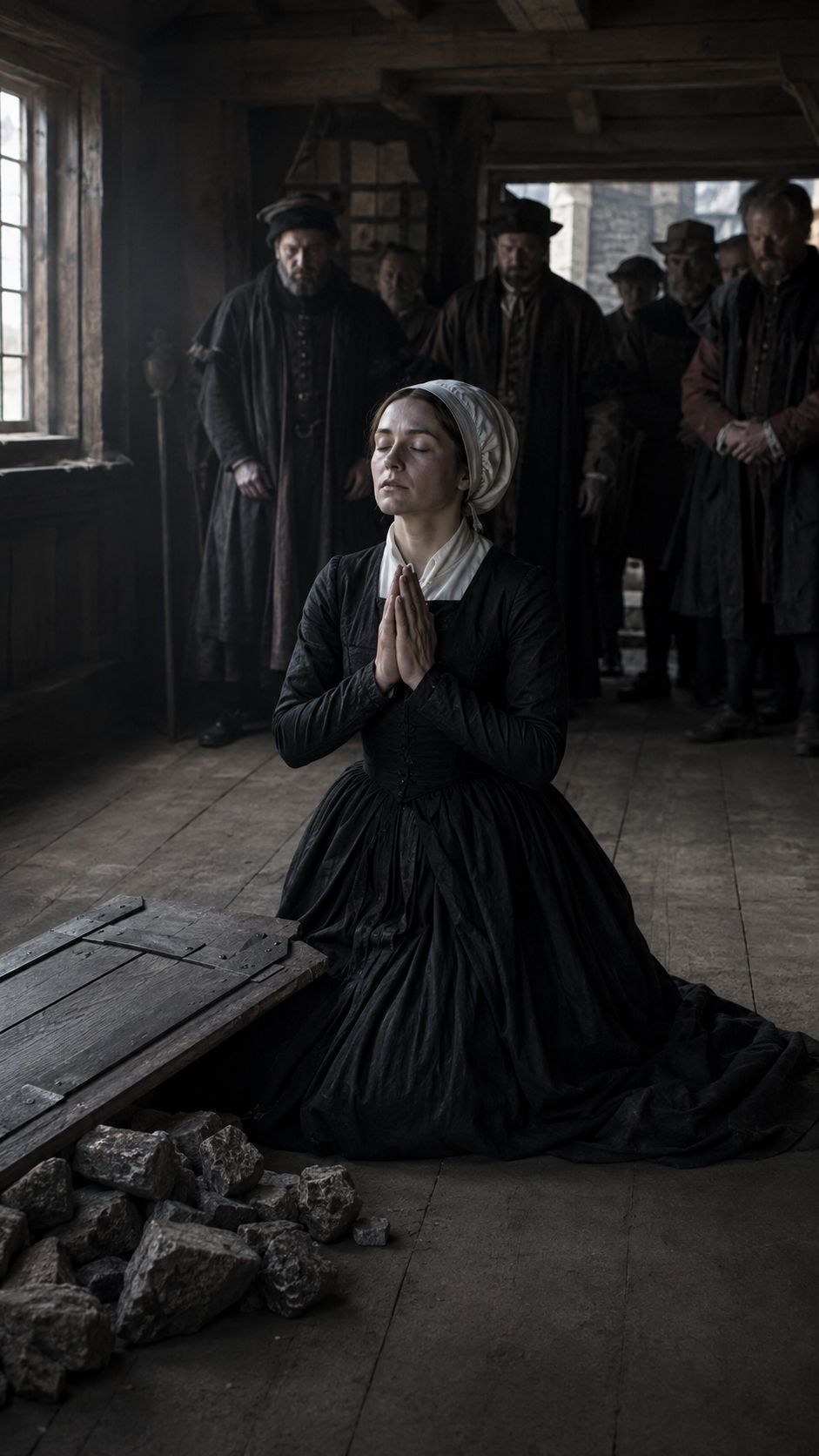 The Pearl Of York, Pressed To Death
A well-liked butcher's wife converted to Catholicism, and Elizabethan York crushed her slowly beneath a door for it.
York, United Kingdom · 1586 · 11 km away
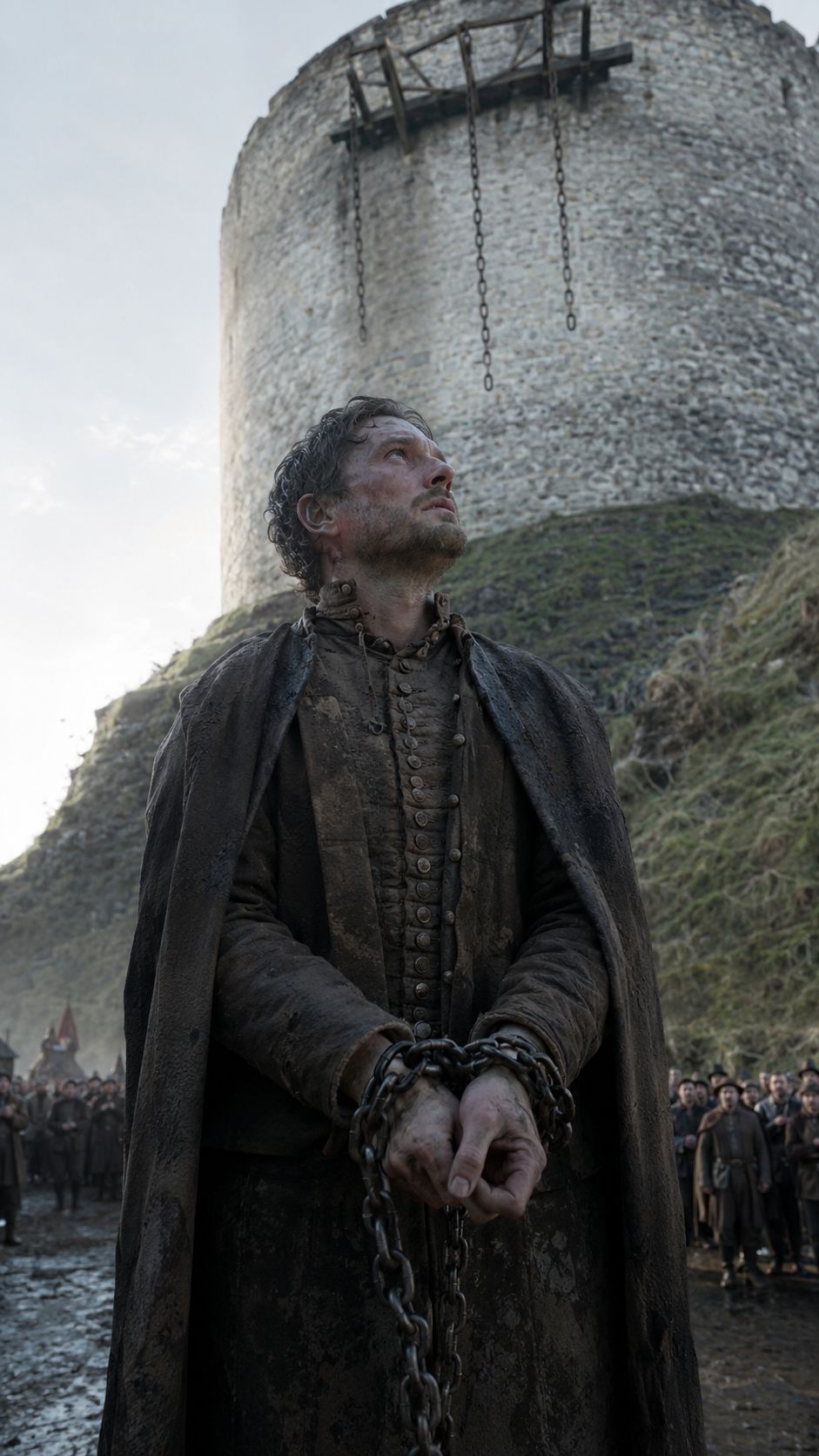 The Rebel Leader Hanged in Chains Over York
He led 30,000 men against the King and nearly won — until false promises brought him back to the city he'd once commanded.
York, United Kingdom · 1537 · 11 km away
- The Horse-Thief Turned Into A Folk Hero
A violent burglar and horse-thief understood one thing perfectly: how to command an audience at his own execution.
York, United Kingdom · 1739 · 11 km away
- The Poisoner Whose Skin Was Sold as Charms
After she was hanged for poisoning a client, her skin was tanned into good-luck charms and sold to the public.
York, United Kingdom · 1809 · 11 km away