In 1202, Pope Innocent III launched the Fourth Crusade to recapture Jerusalem from Muslim control. The crusading army gathered in Venice, which agreed to supply a fleet — for a price the Crusaders could not fully pay.
The Doge of Venice, Enrico Dandolo, offered a solution: if the Crusaders helped Venice capture the Christian city of Zara (Zadar), which had rebelled against Venetian rule, their debt would be reduced. The Pope explicitly forbade an attack on a Christian city. The Crusaders went anyway. Zara fell. They were excommunicated.
Then a Byzantine prince, Alexios Angelos, promised them a fortune and military support if they helped him reclaim the throne of Constantinople. The Crusade was now pointed firmly away from Jerusalem.
The Horror
On 12 April 1204, the Crusader army breached the land walls of Constantinople — the largest, richest, and most symbolically important Christian city in the world. A city that had stood nearly nine centuries. A city crammed with the accumulated art, relics, and treasures of both the Roman and Byzantine empires.
For three days, they looted and burned.
Hagia Sophia, the greatest church in Christendom, was stormed. Its altars were stripped of gold and silver, its icons smashed or stolen, its reliquaries broken open. Chroniclers describe soldiers leading horses into the sanctuary, drinking, gambling, and committing violence in the nave. Monks and clergy were killed in front of their altars.
Ancient bronzes that had stood in Constantinople’s streets and forums since late antiquity — including classical Greek works relocated there by earlier emperors — were broken up and melted down for coin. Manuscripts of Greek and Roman texts, some unique, were burned, lost, or scattered across Western Europe. The precise cultural loss can never be measured. The historian John Julius Norwich would later write that Western civilisation suffered a loss “greater than the burning of the Library of Alexandria – perhaps the most catastrophic single loss in all history.”
The Venetians, practised in recognising value, chose what to take rather than melt. They prised the porphyry sculpture of the Four Tetrarchs from a corner of the Philadelphion and built it into a corner of St Mark’s Basilica. They emptied the treasuries of major churches and shipped home chalices, reliquaries, enamels and icons.
And they took the horses.
Four gilded bronze horses — each about 2.3 metres high and over 2.5 metres long — had stood above the starting gates of the Hippodrome, Constantinople’s great chariot stadium, for centuries. Their exact origin is debated (classical Greece or the Roman imperial period), but by the 13th century they were among the most celebrated bronzes in the Christian world.
The Venetians decided they would crown their own basilica. The problem was physical: the horses were huge and heavy. Transporting them whole across the sea was risky. So, according to tradition and supported by the visible joins, they removed the heads from the bodies to reduce the bulk, shipped the pieces separately, and reassembled them in Venice. Decorative collars were fitted around each neck to hide the seams where the heads had been reattached.
Installed above the main entrance of St Mark’s Basilica, facing the Piazza San Marco, they became one of Venice’s defining symbols — trophies from a Christian city taken by a crusade that never reached Jerusalem.
The Modern Relic
Today, the original bronze horses have been moved inside St Mark’s for conservation; weather‑resistant replicas stand on the façade. Even so, the collars around their necks remain clearly visible — ornamental bands that also conceal the cuts and welds made when they were taken from Constantinople and reassembled in Venice.
Fourteen million visitors a year pass through Venice in a typical year. Many photograph St Mark’s and its famous horses; few realise they are looking at looted art from the sack of a Christian capital by a Christian army.
The porphyry Tetrarchs still sit in the corner of St Mark’s, another Constantinopolitan fragment embedded in Venetian stone. The treasury holds reliquaries and enamels whose journey from Hagia Sophia and other churches was written in fire and blood.
In 2004, on the 800th anniversary of the sack of Constantinople, Pope John Paul II formally expressed sorrow and asked forgiveness from the Orthodox Church for the atrocities of 1204. The apology acknowledged the crime. The horses stayed where they were. No timetable for restitution accompanied the words.
Nearby on the Dark Atlas
 The Bride An Emperor Insulted And Never Forgot
A Byzantine emperor mocked a brilliant woman at his own bride show, then rode to her monastery decades later still unable to forget her.
Constantinople, Turkey · 830 · same site
 The Emperor Who Faced The Mob With A Prayer
A Byzantine emperor who showed no mercy to others met his own three-day public destruction with astonishing calm.
Istanbul, Turkey · 1185 · same site
 The Emperor Who Vanished Into The Ottoman Dark
The last Roman emperor took off his purple robes, asked forgiveness of his men, and walked into the final battle of a 1,123-year empire.
Constantinople (Istanbul), Turkey · 1453 · same site
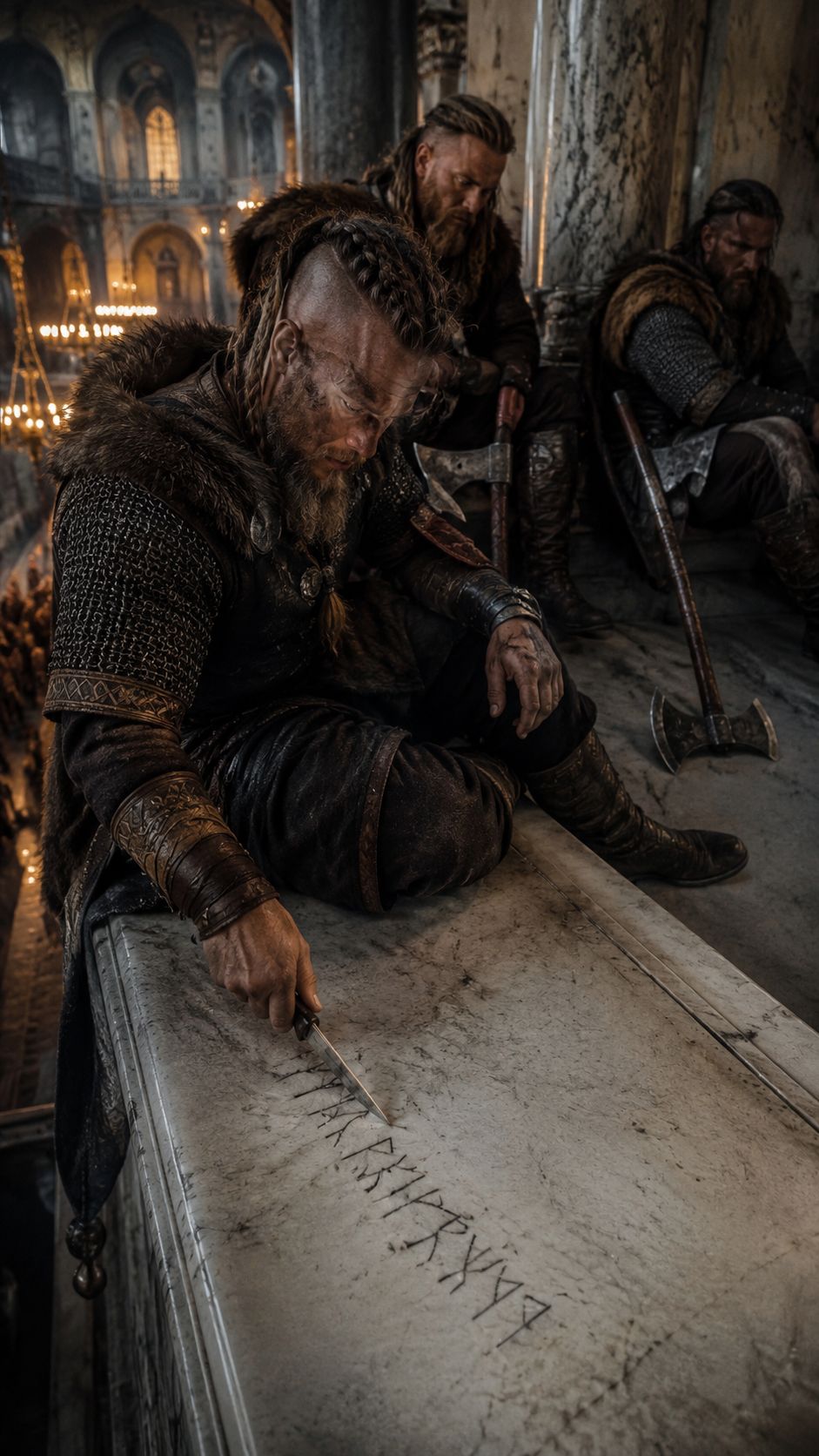 The Viking Who Carved His Name In Hagia Sophia
Bored during an endless imperial church service, a Viking guardsman scratched graffiti into marble that survives a thousand years later.
Hagia Sophia, Istanbul, Turkey · 1050 · same site