On 25th March 1306, Robert the Bruce was crowned King of Scotland at Scone Abbey. The ceremony was rushed — Bruce had just murdered John Comyn in a church and needed a crown on his head before the consequences arrived. There was a problem: the traditional coronation had to be performed by the head of Clan MacDuff. The head of Clan MacDuff, the Earl of Fife, was on the English side.
His wife was not.
Isabella MacDuff, Countess of Buchan, rode to Scone without her husband’s knowledge or permission. She arrived a day late — Bruce had already been crowned. He agreed to repeat the ceremony so that Isabella could place the crown on his head and give the act the MacDuff legitimacy it needed.
She crowned him knowing exactly what would happen to her if the English won.
The English won.
THE HORROR Bruce was defeated at the Battle of Methven three months later. He fled into the Highlands. His female kin — his wife, daughter, sisters, and Isabella — were sent north toward Orkney, hoping to reach Norway and safety.
They never made it. Betrayed by the Earl of Ross, the women were captured and handed over to Edward I.
Edward — a king described even by admirers as possessing a “peculiar ferocity” — decided that Bruce’s women would be made into examples. Not killed. Displayed.
He ordered a cage built for Isabella at Berwick Castle: a lattice of wood and iron, barred and reinforced. She was confined inside it in one of the castle’s turrets. Edward’s initial order specified that she should be “hung up out of doors in the open air at Berwick, that both in life and after her death she may be a spectacle and eternal reproach to travellers.”
Whether the cage was literally open to the weather or set within a tower room is debated. What is not debated: Isabella was locked in a lattice cage, visible to visitors, forbidden from speaking to any Scot, attended only by English women who brought food and emptied waste.
She was treated like an exhibit in a royal menagerie.
Mary Bruce — Robert’s 24‑year‑old sister — received the same punishment at Roxburgh Castle. Same cage principle. Same enforced isolation. Same intent: a living warning.
Edward ordered a third cage for Bruce’s daughter Marjorie. She was twelve years old. At the last moment, he changed his mind and sent the child to a convent instead. Whether this was mercy or calculation has been argued for more than seven centuries.
Isabella remained in her cage for four years, from 1306 to 1310. From the turret at Berwick she could see across the border into Scotland — the country whose king she had crowned, the country she could not enter, the country fighting a war she had helped start by placing a crown on a rebel’s head.
In 1310, Edward II — who lacked his father’s appetite for theatrical cruelty — ordered Isabella transferred to the Carmelite friary at Berwick. In 1313, she was moved again into the custody of a noble. Then the record falls silent.
When Bruce’s female relatives were finally returned to Scotland after the victory at Bannockburn in 1314 — exchanged for captured English lords — Isabella was not among them.
She was almost certainly already dead. Four years in a cage had wrecked her health. The woman who defied her husband to crown a king died before she could see that king win.
THE MODERN RELIC There is no tomb and no memorial for Isabella MacDuff.
Berwick Castle is largely gone — fragments of wall and earthworks remain, cut through by the railway that now crosses the site. Roxburgh Castle, where Mary Bruce was caged, survives only as a ruin. Scone Abbey, where Isabella placed the crown on Bruce’s head, was destroyed in the Reformation; its traces lie beneath later buildings.
The Stone of Scone itself spent most of the 20th century in London before being returned to Scotland in 1996. Bruce has a towering equestrian statue at Bannockburn, thirteen feet high, facing south across the battlefield. His face appears on Scottish banknotes.
Isabella has nothing visible. No statue, no plaque, no named street.
The woman who rode alone to crown a king against her husband’s allegiance, who was caged for four years within sight of her own country, and who died before the victory she helped make possible, lives mostly in footnotes and fragments.
Bruce is on monuments and money. Isabella is in a cage that was dismantled, in a castle that was demolished, in a story that still rarely makes it onto the battlefield tour.
Nearby on the Dark Atlas
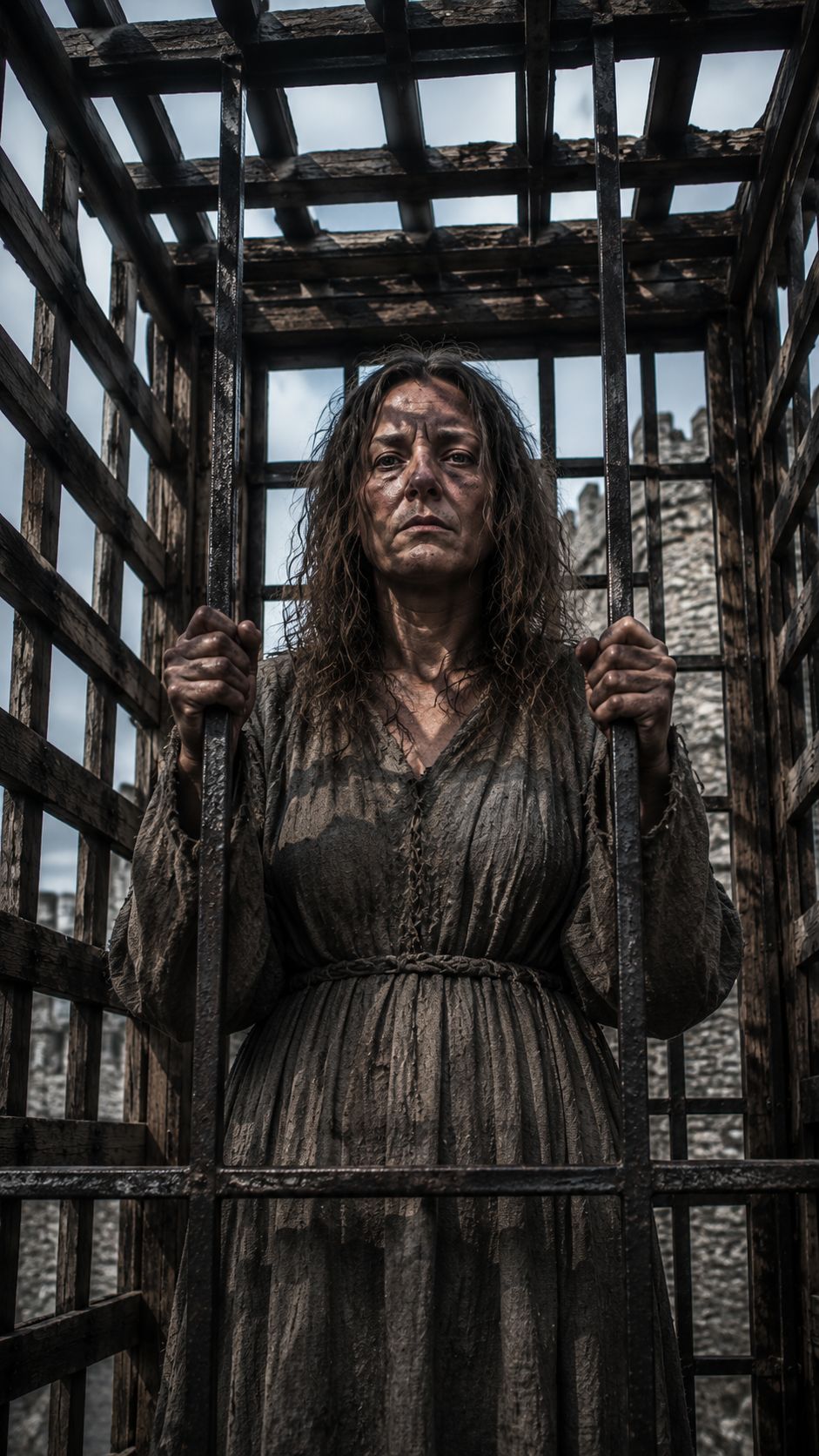 Caged Above Berwick Castle
For crowning Robert the Bruce with her own hands, an English king locked her in an open cage on a castle wall for years.
Berwick-upon-Tweed, United Kingdom · 1306 · same site
 The Dragons That Came By Sea
Strange omens filled the Northumbrian sky before Vikings landed at Lindisfarne and shattered 150 years of monastic peace.
Lindisfarne, United Kingdom · 793 · 17 km away
 The Renaissance King Who Lost His Head For Honour
Scotland's most brilliant king marched to war for an old alliance, and his skull ended up as a curio on an Englishman's shelf.
Flodden Field, United Kingdom · 1513 · 19 km away
- England's Most Fought-Over Haunted Castle
Centuries of border warfare and torture wrote Chillingham's darkness into history long before anyone spoke of ghosts.
Chillingham, Northumberland, United Kingdom · 1245 · 28 km away